
CULINARY CHRONICLES · MASALA UNIVERSE · 13

Goan Recheado Masala
The Fiery Heart of Goan Kitchens
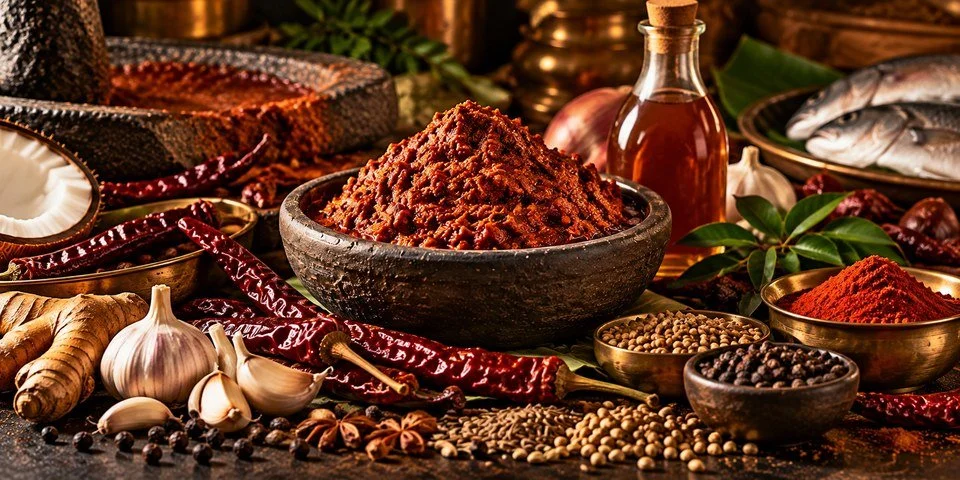
A Fish, a Slit, a Red Promise
Before the fish reaches the pan, there is a small act of preparation that tells us what sort of meal is coming. Slits are filled with red paste. The seasoning is given somewhere to sit, and the fish carries it into the heat. In the Goan practitioner accounts examined here, recheado belongs very clearly to that moment. [R1, R3]
The paste brings chilli, acidity and aromatics together. Calling it fiery describes only part of the encounter. A dish that offers nothing beyond heat has left most of the ingredients unemployed; recheado gives them a more interesting arrangement.
To understand its character, watch what the cook needs the paste to do. It must season, hold together and work with the food carrying it. Its thickness is not merely a detail for the photograph. The texture belongs to the way the dish is made.
A Portuguese Word at a Goan Stove
Priberam’s Portuguese dictionary defines the culinary sense of recheado as filled with a preparation or another food. ‘Stuffed’ is therefore a sound way into the name. At the stove, the word has an unusually direct illustration: the paste goes inside the prepared fish. [R5]
The language connection is real; it does not give us a dated recipe by itself. What we can see more closely is the family kitchen. Celebration In My Kitchen recalls grinding the masala on stone before household blenders were available, including the remembered sting of chilli on the hand. That memory belongs to the writer, and brings the preparation into human scale. [R1]
Read beside the name, the account offers two kinds of inheritance: a culinary word and a remembered practice. Neither needs to be stretched into an unsupported origin legend. There is plenty to notice in how people continue to make and use the paste.
Heat Needs Good Company
The Celebration In My Kitchen formula combines dried chilli, garlic, pepper, cloves, cinnamon, cardamom, cumin and turmeric with vinegar, tamarind and a little sugar. Each belongs to the balance rather than a competition for loudness. [R1]
Chilli supplies pungency; vinegar brings acidity as well as liquid for grinding. Aromatics give the mixture another dimension, and the sour-sweet adjustment lets the cook shape the result. This is our culinary reading of the combination: heat has a setting, rather than standing alone as a test of endurance.
Clyde’s Goan Food Recipes presents two different formulas, with visibly different colours and seasoning choices. GOYA records Ruth Sequeira’s grandmother Ida’s version. Together, these accounts make the paste more interesting than a standard ingredient checklist: there are several ways for a recognisable idea to reach the plate. [R3, R4]
From the Grinding Stone to the Pan
The stone-grinding memory connects effort with texture. Today, the practitioner’s blender instructions still seek a fine, thick paste. The appliance changes; the intended result remains legible. A stuffing needs consistency as well as flavour, because the cook must put it somewhere and expect it to stay. [R1]
Vinegar is the grinding liquid in Clyde’s two versions. Ida’s recipe, by contrast, uses a water-extracted tamarind pulp before vinegar is added. The difference is small on a shopping list but instructive at the grinder: ‘never any water’ cannot be made into a rule for every documented household method. [R3, R4]
The university-hosted Rechado account also describes a vinegar-ground preparation for fish. What these sources share is a wet seasoning intended for cooking, rather than a powder made by borrowing Goda’s roasting sequence. [I1]
Grinding distributes the ingredients; the pan takes the preparation into the dish. Reading those stages together is more useful than treating a jar of paste as the finished meal.
Every Household Balances the Fire
Celebration In My Kitchen records a mother’s preference to omit ginger for fish while acknowledging other cooks’ use of it. Clyde includes ginger in his versions, and it appears in Ida’s recipe too. The disagreement is precisely the sort of evidence that a household archive should welcome. [R1, R3, R4]
Clyde labels one contributor’s formula a Salcete version. We can preserve that attributed description without claiming it represents the entire locality. A named cook’s account is valuable because it gives us a place to begin asking questions, rather than permission to stop asking them. [R3]
The practical differences invite tasting rather than policing. How sharp should the acidity be? How much sweetness belongs in the balance? Which aromatics should remain noticeable? Those are meaningful decisions for the cook and the people eating. Calling one version authentic by excluding the others would remove some of the best evidence we have of a living tradition.
The Seafood Keeps Its Place
Mackerel and pomfret appear in the practitioner’s stuffed-fish preparations; Clyde also describes mackerel filled and coated before frying. The method lets the paste accompany the flesh rather than remain a separate spoonful at the edge of the plate. [R1, R3]
Contemporary Goana Foods descriptions extend its marketed uses to prawns, chicken and vegetables. Ruth Sequeira’s account also names applications beyond stuffed fish. Those examples show versatility while keeping their particular sources visible. [R2, R4]
The cook still has to consider the carrier. A paste can have a forceful character without being given the entire stage. In our reading, the point of seasoning seafood is a balanced mouthful in which both the fish and the work of the masala are recognisable. Fire is memorable; so is knowing when to let the rest of dinner speak.
More Than a Red Paste
The preserved Spice Codex connections trace chilli, pepper, clove, cinnamon, cardamom, cumin and turmeric from the original pilot formula. Garlic, vinegar and tamarind are central to understanding that preparation too, even though the current Spice register has no Masters for them. The archive should acknowledge an important ingredient without inventing a link. [R1]
Recheado also has a place beside Xacuti and Cafreal in the Masala registry. Keeping those identities separate lets a reader explore Goan preparations without assuming that every paste is another version of the same recipe.
Return to the fish before the pan: a careful slit, a prepared paste, a cook deciding how this meal should taste. The Portuguese word tells us something about the action; the household accounts tell us something about the people performing it. Between language and practice, a familiar preparation keeps finding its way to the table. That is a story we can taste.
At the Edge of the Story
Evidence: R1 supplies practitioner technique and personal/family memory; R3 documents Clyde’s recipe and a contributor-attributed Salcete version; R4 records Ruth Sequeira’s grandmother Ida’s recipe. R5 verifies the Portuguese culinary meaning. I1 is narrow instructional corroboration; R2 is a manufacturer’s account of current use, not independent historical evidence. Sensory explanations and reflections on cooking decisions are editorial interpretation.
Pending: the historical route of the name and preparation, chronology, wider community testimony, vinegar traditions and safe storage guidance. No origin date, inventor, universal community practice, medical benefit, GI registration or fixed shelf life is asserted. Stone-grinding memories are attributed to their source rather than voiced as Shankar’s own recollection. All original source references and Spice Codex links remain.
- I1 · Indian Masalas — Author not identified in retrieved teaching document; hosted by CSJMU Gyan Sanchay. University-hosted instructional material; provenance incomplete. Locator: PDF pages 7 (Garam Masala), 11 (Goda Masala), 13 (Rechado Masala). Accessed 2026-10-08.
- R1 · Recheado Masala — Celebration In My Kitchen; author name not confirmed from retrieved page. Goan practitioner recipe and first-person family memory, 22 May 2015. Locator: Opening account, paste recipe, notes and seafood preparations. Accessed 2026-10-08.
- R2 · Recheado Masala — Goana Foods. Goan manufacturer’s product/use description; commercial interest. Locator: How to enjoy; FAQ. Accessed 2026-10-08.
- R3 · Recheado Masala — Clyde / Goan Food Recipes; contributor Roselyn. Practitioner recipe with contributor-attributed regional variant, 27 September 2012. Locator: Opening account, two ingredient lists and fish-fry instructions. Accessed 2026-10-08.
- R4 · Make Perfect Goan Fish Fry With This Recheado Masala Recipe — Ruth Sequeira, published by GOYA (intro spells surname Sequiera). Attributed grandmother’s recipe published by culinary journal, 12 May 2021. Locator: Introduction; Ida’s recipe ingredients and method. Accessed 2026-10-08.
- R5 · Recheado — Dicionário Priberam da Língua Portuguesa — Priberam. Portuguese dictionary, primary lexical reference. Locator: Adjective, culinary sense 4; participle of rechear. Accessed 2026-10-08.