
Gujarat Cuisine — Where Geography, Faith and Trade Sit Down for a Thali
Food • Culture • Stories — a regional journey through Kutch, Kathiawad, North and Central Gujarat, Surat, tribal foodways, faith, trade and farsan.
← Back to Culinary ChroniclesIf there is one thing Gujarati food suffers from, it is excellent public relations for the wrong reasons.
Ask someone outside Gujarat what Gujarati food is and the answer will usually arrive on schedule: “Dhokla.” “Fafda.” “Everything is sweet.”
That is rather like describing all of Italy through pizza.
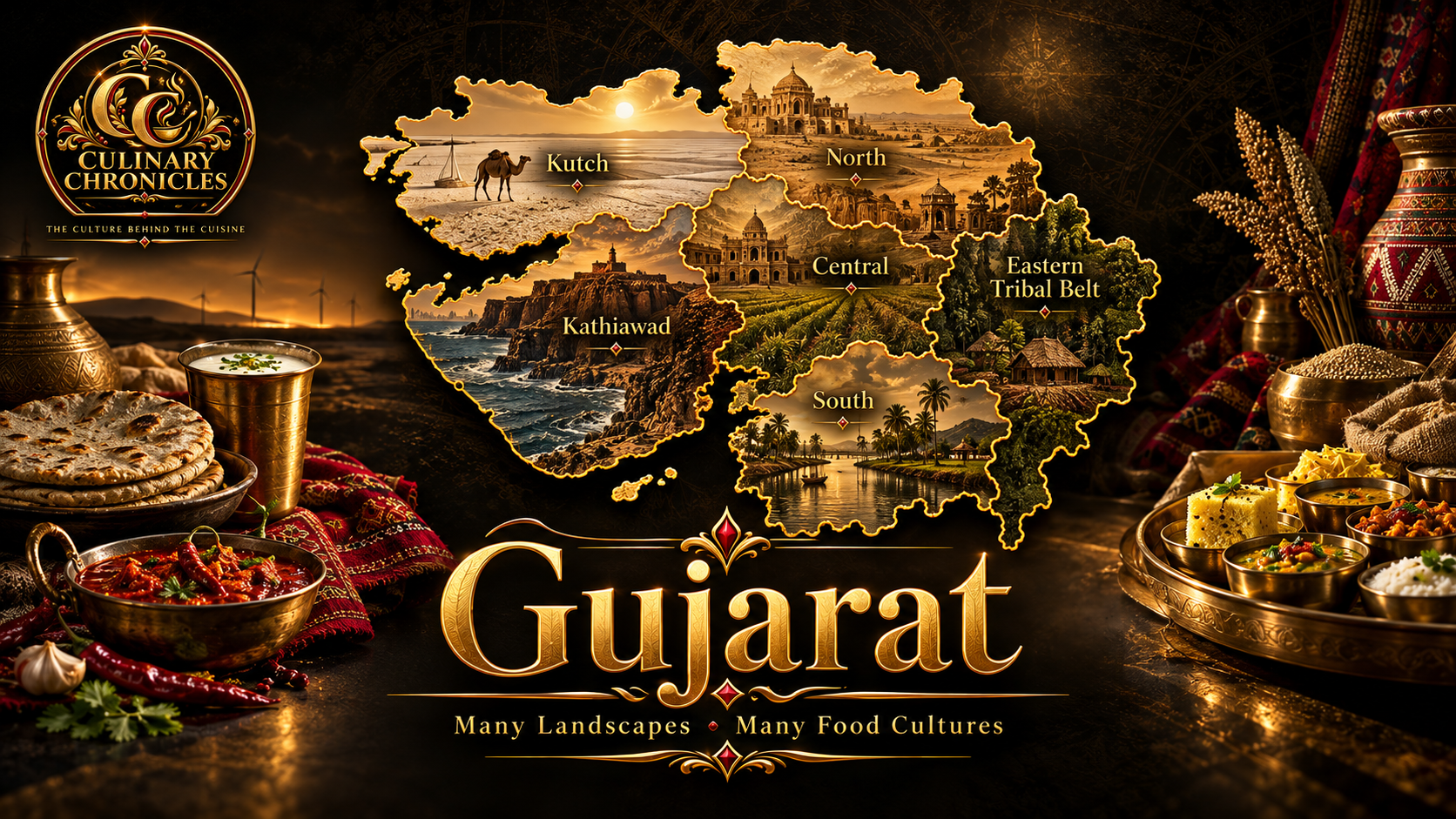
Gujarati cuisine is not one cuisine. It is a conversation between Kutch, Saurashtra, North Gujarat, Central Gujarat, South Gujarat and the tribal eastern belt—each speaking with a different accent, each shaped by its own rainfall, soil, agriculture, trading history and communities.
Kutch — Where Scarcity Learnt to Cook
Start in Kutch.
This is a landscape of salt flats, dry grasslands, pastoral communities and long distances.
Naturally, the cuisine behaves accordingly.
Bajra, khichdi, kadhi, dairy and foods that store or travel well become important. Bajra rotla with curd or chaas is not rustic nostalgia here—it is logical food engineering for an arid region.
The cuisine is economical without being poor. That distinction matters.
Where ingredients are limited, technique becomes richer.
Rotla. Kadhi. Khichdi. Chaas. Pickles. Chutneys.
And then Kutch decides simplicity has gone on long enough and invents Dabeli.
A bun filled with spiced potato, chutneys, peanuts, sev and pomegranate.
Someone clearly looked at the austerity of the Rann and said: “We need a snack with personality.”

Saurashtra and Kathiawad — Please Pass the Chilli
Travel into Saurashtra and Kathiawad and the food suddenly develops an opinion.
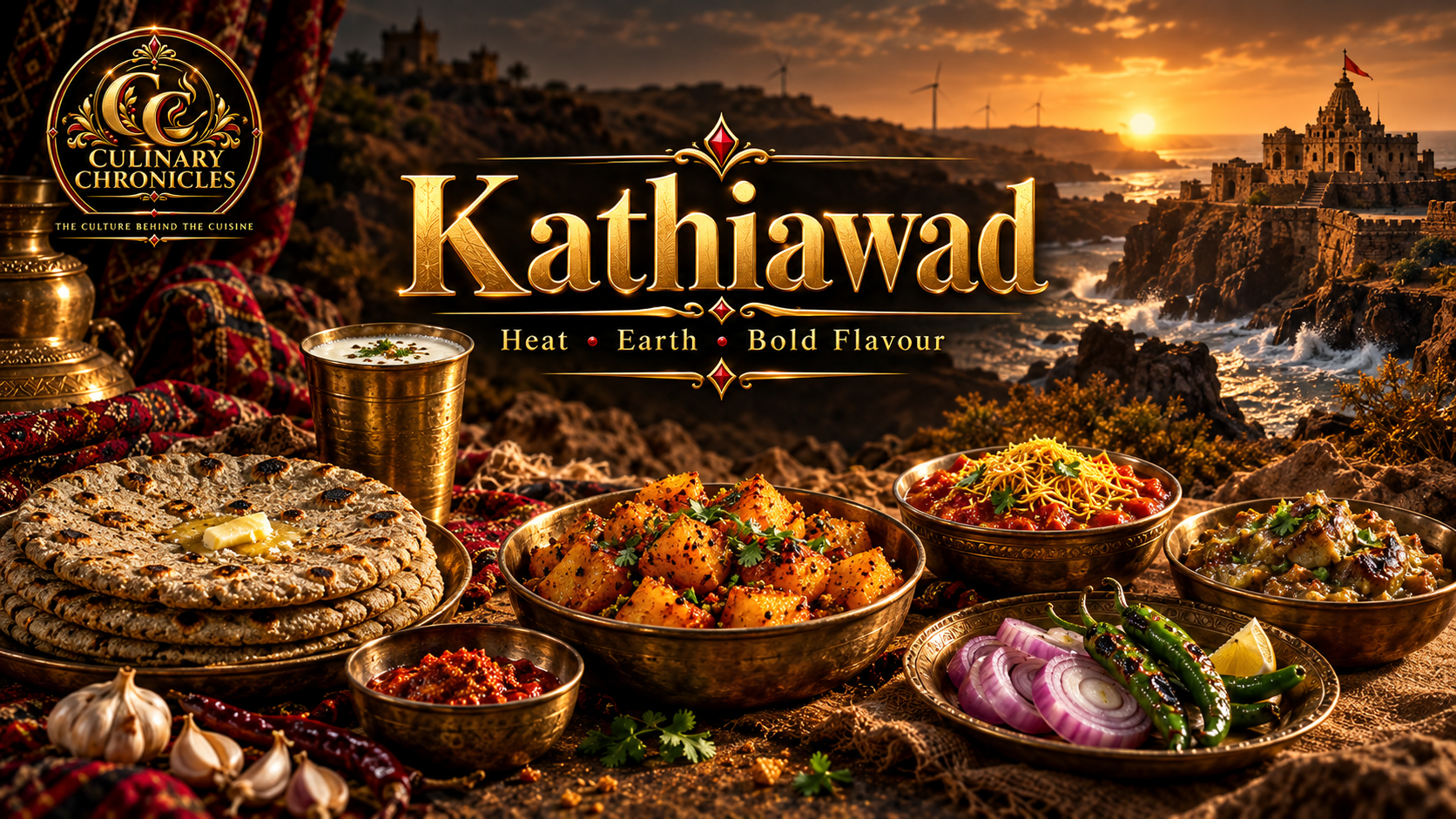
Bajra rotla arrives with ringan no olo, garlic chutney, sev tameta, lasaniya bateta, kadhi and enough chilli to make you reconsider the stereotype about Gujarati sweetness.
This is food shaped by dry land, farming, pastoral life and strong flavours.
Garlic is not an ingredient here. It is a declaration.
If Central Gujarat invites you to a thali politely, Kathiawad grabs a chair and says:
“Sit. Eat.”
And then watches to see whether you can handle the chutney.
North Gujarat — Grain, Dairy and Quiet Confidence
North Gujarat speaks in a calmer register.
Think Patan, Mehsana, Banaskantha and Sabarkantha.
Bajra, maize, wheat, pulses, dairy, sesame.
Rotla, dhebra, khichdi, dal, kadhi, chaas.
This is food from agricultural and pastoral traditions where grain and dairy work together efficiently.
And Gujarat’s relationship with buttermilk deserves its own dissertation.
Chaas is not merely a beverage.
It is hydration, digestion, hospitality and occasionally peace treaty.
Which means somewhere in Gujarat, centuries before corporate mediation workshops, somebody had already discovered that difficult conversations improve significantly when dairy is involved.
Central Gujarat — The Thali Learns Project Management
Then comes Ahmedabad, Vadodara, Anand, Kheda and the central plains.
Here the Gujarati thali begins behaving like an organizational chart.
Rotli. Dal. Kadhi. Shaak. Kathor. Rice. Farsan. Pickle. Papad. Chutney. Chaas. Sweet.
Everything has a role.
Nobody is redundant.
And somehow all departments report simultaneously.
The Gujarati thali is not excess for the sake of excess. It reflects an old meal logic in which texture, grain, pulse, vegetable, dairy, sweet, sour and spice are balanced across the plate.
Central Gujarat also gave farsan the confidence to become an entire food category.
Dhokla. Khaman. Khandvi. Muthia. Handvo. Patra.
The Gujarati looked at the concept of “snack” and apparently decided one word was insufficient.
So they created farsan.
Problem solved.

South Gujarat — Surat Refuses Restraint
Then you reach South Gujarat.
Surat, Bharuch, Navsari, Valsad.
Wetter. Greener. Closer to the sea. More cosmopolitan.
And historically deeply connected to trade.
You can taste that openness in the region.
Surti locho. Sev khamani. Ponk. Undhiyu. Ghari.
Farsan in forms that seem to multiply every time you turn around.
Surat has a famous Gujarati saying associated with it:
Surat nu jaman, Kashi nu maran.
To eat in Surat and die in Kashi—apparently one constitutes a good meal and the other a good exit strategy.
Even undhiyu feels like a vegetable committee meeting where everyone has been invited: seasonal beans, roots, eggplant, fenugreek dumplings and spices, all cooked together until hierarchy disappears.
The Eastern Tribal Belt — Before the Thali Became Famous
Eastern Gujarat often gets left out of popular food conversations.
That is unfortunate.
In the hill and forest belts of Dang, Dahod, Chhota Udaipur, Narmada and Panchmahal, Adivasi food traditions historically depended on maize, millets, tubers, greens and seasonal forest produce.
This is an older ecological logic of eating:
Eat what the land gives. Eat seasonally. Waste little. Cook simply.
Long before millet acquired wellness branding and appeared on expensive urban menus, communities here were eating it because it made agricultural sense.
Sometimes tradition is merely sustainability that existed before someone invented the PowerPoint presentation.

Why So Vegetarian?
Gujarati cuisine’s strong vegetarian identity cannot be understood without Jain and Vaishnav traditions.
Jain dietary principles shaped highly disciplined approaches to vegetarianism, including in many households the avoidance of root vegetables such as onion, garlic and potato.
Vaishnav traditions reinforced vegetarian, temple and satvik food cultures across large parts of the state.
The culinary result is extraordinary.
When meat is removed from the centre of the plate, cooks do not simply remove meat.
They build something else.
Pulses gain importance.
Dairy gains importance.
Gram flour becomes a universe.
Vegetables acquire technique.
Fermentation, steaming, tempering and preservation become sophisticated tools.
Restriction did not reduce creativity. It provoked it.
But Gujarat Is Not Only Vegetarian
And this is where the popular image becomes misleading.
Gujarat’s long coastline, ports and migrant communities created food cultures beyond the vegetarian thali.
Parsis, particularly around Navsari, Udvada and Surat, developed a cuisine where Persian memory met western Indian ingredients.
Dhansak. Patra ni machhi. Salli boti. Akuri. Lagan nu custard.
Then come the Dawoodi Bohras, with their remarkable tradition of eating communally from the thaal—turning a meal into social architecture.
Dal chawal palidu. Biryani. Kheema preparations. Khichro. Meat curries. Sweet dishes shared around one plate.
Food here is not simply consumed.
It organizes the community.
There are also Muslim, Koli, coastal and fishing communities whose meat and seafood traditions complicate any attempt to describe Gujarat as one uniformly vegetarian table.
Trade Came to Gujarat Hungry
Gujarat has spent centuries facing the Arabian Sea.
And ports are rarely good at keeping cuisine pure.
That is their charm.
Bharuch, Surat, Khambhat and other trading centres connected western India with Arabia, Persia, East Africa and Europe over long periods.
Traders bring goods.
They also bring habits.
Ingredients.
Techniques.
Food memories.
Communities settle.
Recipes marry.
Words change.
And eventually everybody forgets which grandmother started it.
This is perhaps why Gujarat’s food identity is simultaneously conservative and adaptable.
Faith holds one side. Commerce pulls the other. The thali sits comfortably in the middle.
And Then There Is Farsan
Gujarati eating patterns deserve one final observation.
Many cultures eat three meals.
Gujaratis appear to have regarded the gaps between those meals as an administrative oversight.
Hence farsan.
Thepla for travel.
Khakhra when something crisp is required.
Fafda when jalebi feels lonely.
Dhokla when fermentation has finished its work.
Khandvi when gram flour wants to become silk.
Ganthiya because tea should never have to sit alone.
A Gujarati leaving home for a six-hour journey can sometimes carry provisions suggesting a minor expedition across Central Asia.
This is not over-preparation.
It is culture.
The Gujarati Table
So what is Gujarati cuisine?
It is Kutch learning thrift from the desert.
Kathiawad answering heat with more heat.
North Gujarat bringing grain and dairy to the table.
Central Gujarat turning balance into the thali.
Surat converting prosperity into appetite.
Tribal Gujarat reminding us that millets were sensible long before they became fashionable.
It is Jain discipline, Vaishnav devotion, Parsi adaptation, Bohra community, pastoral practicality and mercantile curiosity.
It is a cuisine shaped by scarcity and prosperity, drought and coastline, temples and ports.
And perhaps that famous hint of sweetness says something about Gujarat itself.
A trading culture must negotiate.
A vegetarian kitchen must innovate.
A dry landscape must conserve.
And a Gujarati meal must somehow make room for sweet, sour, salty, spicy—and one more helping.
It asks, “Why have you stopped?”