
CULINARY CHRONICLES · MASALA UNIVERSE · 17

Kerala Coconut Masala Traditions
One Coconut, Several Ways to Build Flavour
What It Is — A Family of Preparations
A coconut does not arrive in a Kerala kitchen with instructions to become the same thing every time. Grate it, grind it fresh or roast it before grinding, and different possibilities open up. The useful question is not simply whether a dish contains coconut, but what the cook has done with it. [K1, K2, K3]
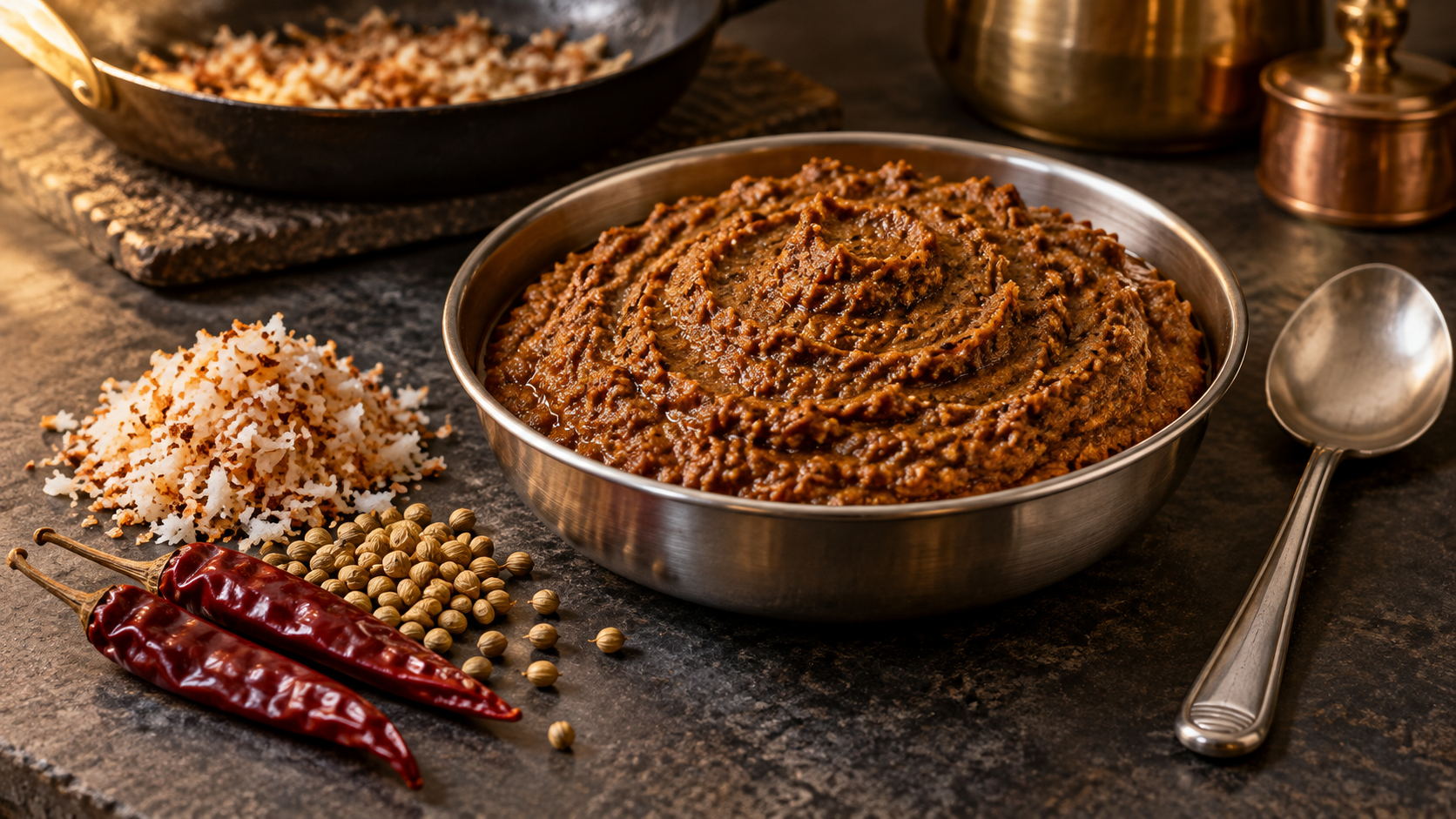
This chapter's title is an editorial umbrella, not the name of one traditional packet mix. Our main example is Lathiya Shanmugasundaram's roasted-coconut paste for ulli theeyal, set beside a contrasting fresh preparation for avial. [K1, K3]
Origin — Place Without a Single Inventor
These documented preparations belong within Kerala's culinary repertoire. They do not establish one invention date or a person who first discovered that coconut could enter the grinder. A household method and a whole region's history are different scales of evidence. [K1, K2, K3]
What we can follow closely is the work: browning, cooling, grinding and combining ingredients. The character of a dish often begins before its gravy exists.
Where the Ingredients Grow — Coconut and a Wider Pantry
ICAR documents coconut-based farms in Kerala's coastal Alappuzha and Kollam districts. That is evidence of cultivation and livelihoods, not proof that the coconut palm originated in Kerala. A regional kitchen need not be the botanical birthplace of every plant it uses. [A1]
Coriander seed brings another agricultural geography: ICAR's spice institute identifies Rajasthan and Madhya Pradesh among its major growing areas. Here, local culinary practice and a wider ingredient supply can meet in the same pan. [A2]
Names — Follow the Dish
Ulli theeyal, avial and varutharacha chicken curry are documented preparation names. They help us locate particular techniques rather than provide interchangeable labels for one masala. Kerala Tourism's varutharacha chicken recipe, for example, browns coconut with seasoning before grinding. [K1, K3, K4]
We retain the collection's English umbrella title without inventing a universal Malayalam name for everything it covers.
How It Is Used — The Roasted Example
Lathiya's theeyal paste uses grated coconut, dried red chillies, coriander, cumin and fenugreek. These are roasted in a little oil until the coconut browns, then cooled and ground with water. Shallots and tamarind belong to the subsequent curry preparation, not automatically to the grinder. [K1]
Kerala Tourism documents another roasting sequence for theeyal. That difference deserves its own place; combining both instructions would not make the result twice as traditional. [K2]
What It Does — Texture and Toasted Character
Roasting gives the selected paste its brown colour and toasted character, while grinding allows it to become part of the gravy. Brown is the aim in this example; a burnt coconut is not a shortcut to greater authenticity. [K1, K2]
Avial provides the contrast. In Lyla Venu Kumar's documented version, unroasted coconut is ground with cumin and green chilli, then joins vegetables. It is another job for coconut, not a theeyal paste that missed its pan appointment. [K3]
Regional Use — Keep the Forms Distinct
Ulli theeyal, avial and varutharacha chicken curry show different destinations for ground coconut. Olan offers a useful boundary: Kerala Tourism's version uses coconut milk rather than this ground coconut-spice paste. [K1, K3, K4, K5]
Understanding the ingredient means noticing these differences. The coconut may be familiar; the cook's next decision makes the meal.
Sources and Further Reading
- K1 — Lathiya Shanmugasundaram, Ulli Theeyal/Shallots in Roasted Coconut Curry, first published19August2017, modified6November2023.
- K2 — Kerala Tourism, Theeyal, undated.
- K3 — Ms Lyla Venu Kumar via Kerala Tourism, Avial, undated.
- K4 — Kerala Tourism, Varutharacha Chicken Curry, undated.
- K5 — Kerala Tourism, Olan, undated.
- A1 — ICAR/CPCRI, Farm Level Adaptations for Climate Resilience Turn the Coastal Tracts Evergreen, undated, reports2012–15demonstrations.
- A2 — ICAR-IISR, Coriander, undated.
By Shankar Manapragada