
CULINARY CHRONICLES · MASALA UNIVERSE · 18

Mangalorean Green Masala Traditions
A Family of Greens, Ground for the Meal
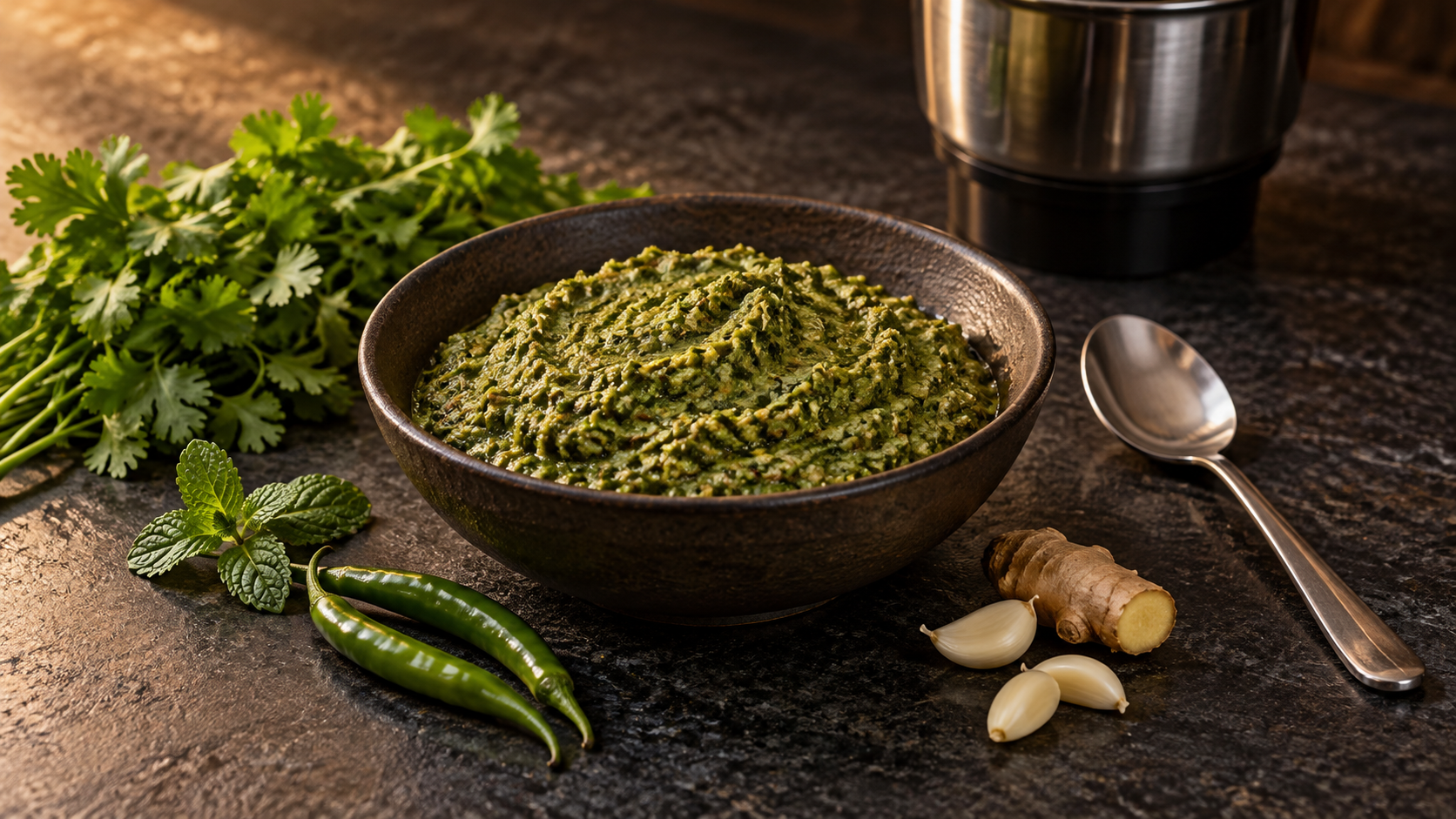
What It Is — Green Is a Beginning
A green masala tells you something about the leaves in the grinder, but rather less about the meal ahead. In Shireen Sequeira's Mangalorean repertoire, green preparations lead towards curries, a fish marinade and biryani. The colour is a useful clue; it is not the whole address. [G1, G2, G3]
Our main example is her coconut-free chicken green-curry paste. This chapter's registered title gathers related preparations; it does not prescribe one mixture for every Mangalorean kitchen. [G1]
Origin — A Kitchen Has More Than One Answer
Sequeira remembers her mother making three green-curry approaches: one with yoghurt, another with coconut milk and a more elaborate base for green biryani. This is her attributed family memory, not a history imposed on an entire region. [G2]
It also explains why a single ingredient list would be inadequate. Even within one household, the intended meal could change what went into the preparation. No verified invention date is needed to appreciate that practical variety.
Where the Ingredients Grow — Leaves Are Not Seeds
Tamil Nadu Agricultural University distinguishes harvesting coriander for leaves from harvesting its mature fruits. Its guidance identifies growing districts including Thoothukudi and Coimbatore. These are cultivation examples, not evidence about where Sequeira buys her herbs. [A1]
ICAR also documents ginger farming in East Sikkim. A Mangalorean preparation can draw on plants cultivated far beyond the region; the identity of a recipe and the agricultural geography of its ingredients are different stories. [A2]
Names — Keep the Household in View
Chicken Green Curry and Fish Green Masala Fry are Sequeira's documented dish names. We retain the collection's English umbrella without supplying an unverified Konkani or Tulu equivalent. Nor does green colouring alone make these preparations interchangeable with Goan cafreal. [G1, G3]
A familiar colour should invite a closer look, not end the enquiry.
How It Is Used — Grind, Then Cook
For the selected chicken preparation, coriander and mint join onion, garlic, ginger, poppy seeds, turmeric, green chillies, cinnamon and cloves. The basic method grinds these directly; it does not prescribe preliminary roasting. The paste is subsequently fried with the onion seasoning. Curds and tomato enter later, rather than automatically belonging in the grinder. [G1]
Her fish marinade differs: mint is optional, tamarind supplies sourness and very little grinding water keeps the coating thick. The two preparations deserve separate instructions. [G3]
What It Does — From Leaves to Gravy
In the chicken recipe, the ground herbs and aromatics become part of a cooked gravy. Sequeira describes its colour turning greenish-brown after curds and tomato are added. A successful curry need not remain the colour of its uncooked leaves. [G1]
The grinder starts the work; the pan gets a vote.
Regional Use — Room for Another Meal
Sequeira's family meal pairs chicken green curry with neer dosa. Her later paneer preparation adapts a family biryani base, demonstrating a contemporary household change rather than an ancient vegetarian pedigree. [G2, G4]
That is the pleasure of following a kitchen closely. A trusted preparation can make room for a different eater, while the next meal still feels recognisably at home.
Sources and Further Reading
- G1 — Shireen Sequeira, Chicken Green Curry (Without Coconut), 26 February 2010; explanation revised 31 July 2012.
- G2 — Shireen Sequeira, Mangalorean Plated Meal Series — Boshi #17, 11 March 2015.
- G3 — Shireen Sequeira, Fish Green Masala Fry, 1 November 2014.
- G4 — Shireen Sequeira, Paneer Green Masala, 22 March 2017.
- A1 — Tamil Nadu Agricultural University, Coriander, undated.
- A2 — ICAR-KVK East Sikkim, Livelihood security of tribal farmer through organic ginger cultivation in Sikkim, undated; reports 2013–18.
By Shankar Manapragada