
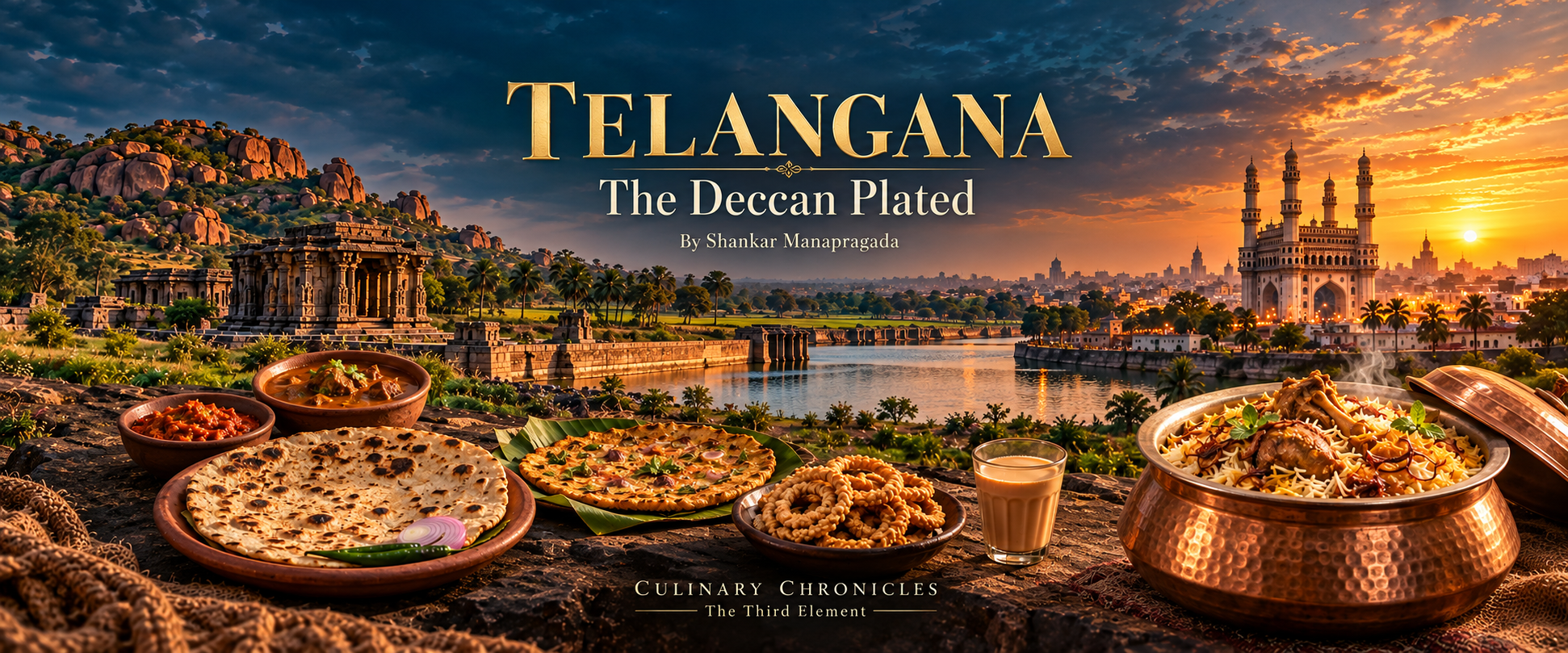
If you believe Telangana is all about Hyderabadi Biryani, you are not entirely wrong. But you are rather like someone who visits the Taj Mahal and concludes that India is primarily in the marble business.
There is considerably more to the story.
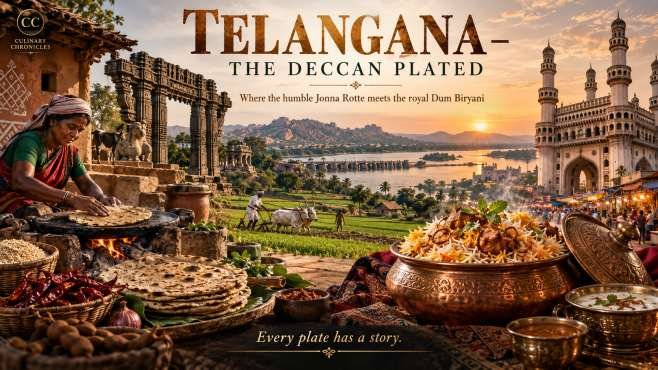
Telangana is a land where a farmer’s humble Jonna Rotte can hold its own against a royal Dum Biryani. Where tamarind makes taste buds sit up in attention, red chillies have absolutely no intention of apologising, and a simple chutney can challenge the authority of an elaborate curry.
To understand Telangana’s cuisine, we must travel beyond Hyderabad’s bustling biryani houses, into its villages, fields, forests, temples, street corners and kitchens.
Because, as I have always believed, to understand a place, don’t just ask what people eat. Ask why they eat what they eat.
A Land That Decided the Menu
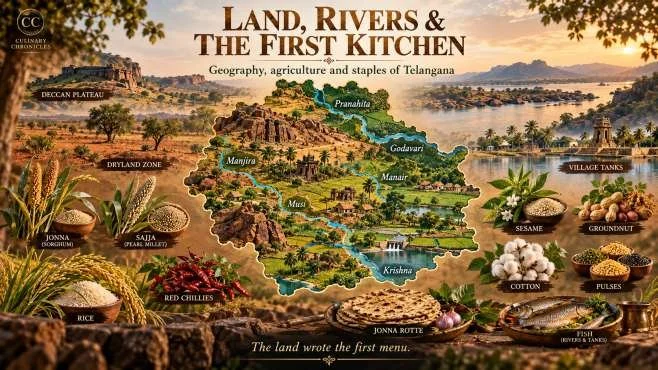
Telangana sits on the Deccan Plateau, where rocky landscapes, hot summers, seasonal monsoons and stretches of semi-arid land have influenced both agriculture and appetite.
The Godavari and Krishna river systems, along with tributaries such as the Manjira, Pranahita, Manair and Musi, have sustained settlements, agriculture and trade. Traditional irrigation tanks, particularly those associated with the Kakatiya period, helped communities cultivate crops in an otherwise challenging landscape.
But these tanks were not merely ponds built to store rainwater. They formed one of the most remarkable community irrigation systems in the medieval Deccan.
The Kakatiya Tank System: Water Held in a Chain
Between roughly the twelfth and fourteenth centuries, the Kakatiya rulers developed and strengthened an extensive network of tanks across the Telangana plateau. The region’s rivers were often seasonal, and rainfall arrived in concentrated monsoon bursts. The challenge was not simply to find water, but to hold it long enough for agriculture, livestock, households and settlements to survive the dry months.
The Kakatiyas answered this challenge by building tanks, bunds, channels and feeder systems that worked with the natural slope of the land.
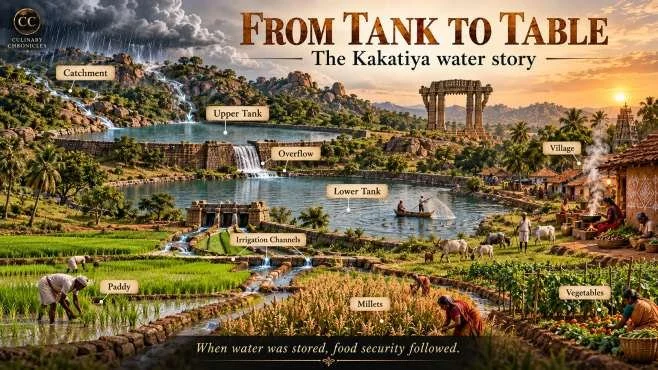
A typical tank was created by constructing an earthen embankment, or bund, across a natural depression or small valley. During the monsoon, runoff from the surrounding catchment flowed into the reservoir. The bund held the water, while carefully designed sluices released it for cultivation.
The system was often arranged as a chain of tanks. When an upper tank filled beyond its capacity, surplus water flowed through channels or overflow arrangements into a lower tank. That lower tank could then store the water again and distribute it to fields farther downstream.
In this way, one rainfall event could serve several settlements instead of disappearing rapidly into a stream or eroding the soil.
The tanks were therefore connected not only by water but also by agriculture, labour and local administration.
Tanks as Agricultural Infrastructure
The importance of these tanks becomes clearer when we consider the agricultural economy of medieval Telangana.
Rainfall was seasonal and uncertain. A single failed monsoon could threaten crops, livestock and household security. Tank irrigation reduced this risk by extending the availability of water beyond the rainy season.
Fields near the tank could support paddy where sufficient water was available. Other areas could be used for pulses, oilseeds, vegetables and fodder. The availability of stored water also encouraged the growth of settlements and markets.
The famous Ramappa Lake, associated with the Ramappa Temple complex, is an example of the close relationship between temple architecture, water storage and landscape planning. The lake helped sustain agriculture in the surrounding area while also forming part of the cultural setting of the temple.
Other historic tanks across Telangana, including Pakhal Lake and numerous village reservoirs, reflect the same broad principle: water infrastructure was integrated into the political, economic and sacred life of the region.
A tank was not hidden infrastructure. It was part of the visible identity of a settlement.
From Tank to Table
The influence of the Kakatiya water system can still be sensed in Telangana’s culinary traditions.
Where tank irrigation supported paddy, rice became available for everyday meals, festive preparations and snacks such as Sarva Pindi and Sakinalu. Where water was less dependable, sorghum, pearl millet, pulses and groundnuts remained essential.
The cuisine did not emerge from a single agricultural model. It emerged from a landscape where irrigated fields, dryland farms, grazing areas, forests and village tanks existed together.
This explains why Telangana’s food culture contains both rice-based delicacies and millet breads, both festive sweets and practical pulse preparations, both freshwater fish dishes and dryland chutneys.
The tank did not replace the plateau’s resilience. It strengthened it.
It allowed communities to use water carefully while continuing to depend on crops suited to the region’s climate.
Two Telugu Tables
Telangana and Andhra Pradesh share the Telugu language, many ingredients and several culinary traditions. Yet their food cultures are not identical.
Andhra cuisine, particularly from the coastal districts, has historically benefited from fertile delta lands and abundant irrigation. Rice is central, while seafood, gongura, coconut, vegetables and a wide range of pickles play important roles. Coastal Andhra cooking often
combines heat with pronounced sourness, while Rayalaseema food is known for intense spice, meat dishes and rustic preparations.
Telangana cuisine developed in a different environment. Dryland farming, tank irrigation and the Deccan’s semi-arid climate encouraged the use of sorghum, pearl millet, pulses, sesame, groundnuts and tamarind. Its flavours are often smoky, earthy, sharp and direct, with chutneys, dry preparations and simple griddle breads holding an important place.
The difference is not a strict rule. Andhra households also cook millet, and Telangana families enjoy rice, seafood and coastal-style dishes. Food travels easily through marriages, migration, trade and television. Still, the broad contrast remains useful.
Andhra food often brings the abundance of the coast and delta to the plate.
Telangana food often reflects the resilience of the plateau and the careful management of its seasonal water.
One is not hotter, better or more authentic than the other. They are two related Telugu culinary worlds shaped by different landscapes, histories and communities.
Even the Telugu language carries regional character. In Telangana, Telugu is spoken with a distinctive rhythm, vocabulary and intonation. Words such as nakko for “I don’t want,” hau for “yes,” and kaiku for “why” are familiar in Telangana speech, especially in Hyderabad and surrounding areas. The language also carries influences from Marathi, Kannada, Urdu and Dakhni, reflecting centuries of movement across the Deccan.
In Andhra regions, Telugu may sound more formal or have different local expressions and pronunciation patterns. Within both regions, dialects change from district to district.
Language, like food and water, refuses to remain inside a neat boundary.
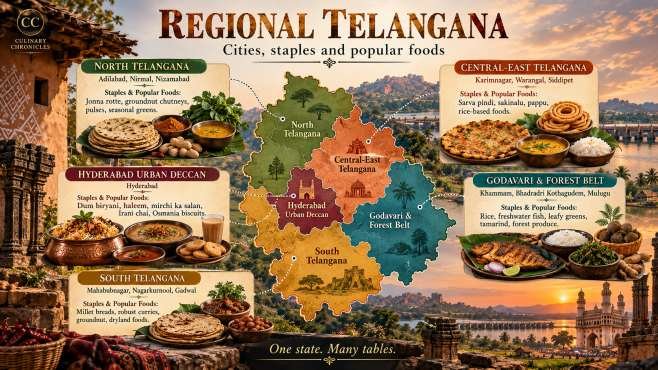
A Cuisine of Many Landscapes
The plateau may provide a broad culinary identity, but Telangana is not one kitchen.
In the northern districts around Adilabad, Nirmal and Nizamabad, the influence of neighbouring Maharashtra is evident. Sorghum rotis, groundnut chutneys, pulses and seasonal greens feature prominently. The food traditions of Gond, Kolam and other Adivasi communities add further diversity, shaped by local crops, forests and seasonal availability.
Around Karimnagar, Warangal and Siddipet, the culinary landscape is closely connected with agricultural settlements and traditional Telugu households. Here one encounters Sarva Pindi, a crisp preparation made from rice flour, sesame, peanuts and chillies.
Think of it as Telangana’s answer to the modern breakfast pancake, except that it arrived without maple syrup, unnecessary marketing or the need for a fancy café.
Then there is Pachi Pulusu, a tangy, uncooked tamarind preparation with onions and chillies. It is refreshing, sharp and wonderfully economical.
In the southern districts around Mahabubnagar, Nagarkurnool and Gadwal, dryland agriculture strengthens the tradition of millet breads, pulses, groundnuts and robust curries. Culinary similarities with northern Karnataka remind us that food has never been particularly interested in administrative boundaries.
Towards Khammam, Bhadradri Kothagudem and the Godavari forest belt, rice, freshwater fish, tamarind, leafy vegetables and forest produce shape local diets. The foodways of Koya and other Adivasi communities offer another perspective on the relationship between people, forests and food.
Across these regions, the same principles recur: use what the land offers, preserve what can be stored, and make every ingredient work hard.
That practical intelligence was supported by the old tank system and later became part of the region’s culinary character.
When the Deccan Met Persia
Hyderabad’s food culture emerged from centuries of cultural interaction, particularly under the Qutb Shahi rulers and later the Asaf Jahi Nizams.
Persianate culinary traditions, Mughal influences, local Telugu ingredients and Deccani cooking practices gradually created a distinct gastronomic identity.
Rice became fragrant, meat became tender, spices became carefully layered, and cooking acquired the patience of a court historian.
The most celebrated ambassador of this tradition is undoubtedly Hyderabadi Dum Biryani. Rice, meat, spices and aromatics are brought together, sealed and gently cooked until their flavours become inseparable.
Dum cooking is a wonderful reminder that sometimes the most important ingredient is patience.
A lesson equally applicable to leadership, parenting and cooking. Although, in my experience, patience is often in shorter supply than saffron.
But Hyderabad’s culinary identity extends far beyond biryani. Mirchi ka Salan, Bagara Baingan, Marag, Pathar ka Gosht, Khatti Dal and Lukhmi reveal the city’s layered culinary history without requiring every dish to compete for the same spotlight.
And then there is Haleem.
A slow-cooked combination of meat, wheat, lentils and spices, Haleem is especially associated with Ramadan. Its preparation requires time, labour and considerable attention.
It is perhaps one of the few dishes where repeatedly stirring the pot is not considered interference.
Hyderabad’s cosmopolitan culture also gave us Irani cafés, where Irani Chai and Osmania biscuits can comfortably sustain conversations ranging from politics and cricket to the question of which establishment serves the best biryani.
The debate, naturally, remains unresolved.
The City Between Meals
To understand Hyderabad today, one must leave the dining room and walk into the street.
The city’s street food is fast, generous and wonderfully democratic. It belongs to office workers, students, shopkeepers, travellers, night-shift employees and families who have stepped out simply because the smell from a roadside stall was impossible to resist.
At breakfast time, stalls serve punugulu, crisp fritters made from fermented batter, often accompanied by chutney. Mirchi bajji brings a chilli wrapped in batter and fried until the outside is crisp and the inside remains gloriously fiery. Bonda, samosa, kachori and dahi puri add their own textures to the city’s snack culture.
Street-style dosa, idli, vada and tiffin stalls reflect the wider South Indian influence that has become part of urban life. In the evenings, shawarma, chicken 65, grilled kebabs and rolls reveal the city’s modern, mobile appetite.
At night, nihari, kebabs, Haleem during Ramadan, and late-night rice and meat dishes draw crowds long after many kitchens have closed.
The city’s street food is not always about culinary purity. It is about adaptation. A dosa may carry a spicy filling, a roll may combine local and global flavours, and a snack stall may serve food that belongs equally to Telangana, Hyderabad and the wider Indian city.
That is the charm of street food: it records what people are eating now.
The Fire, the Tang and the Humble Chutney
If one were to describe traditional Telangana cuisine in a few words, they would be spicy, tangy, earthy and unapologetically bold.
Red chillies provide the heat. Tamarind delivers acidity. Sesame and groundnuts lend body and nuttiness. Pulses and grains offer substance, while local greens and vegetables provide variety.
Unlike cuisines that rely heavily on rich gravies, many rural Telangana preparations celebrate direct and assertive flavours.
Golichina Mamsam, for example, is cooked until the masala clings beautifully to the meat. A seasonal leafy curry may be prepared with little more than tempering, chilli and patience. A chutney can transform a plain meal into something memorable.
There are no elaborate garnishes, no towers of food, and certainly no artistic drizzle designed to confuse the diner.
Just honest food.
And in my view, some of the finest culinary experiences come from kitchens where flavour takes precedence over presentation.
When Food Becomes a Celebration
The everyday pantry becomes especially expressive during Telangana’s festivals, when food connects agriculture, faith, memory and community.
Bathukamma, the celebrated floral festival, honours nature and the feminine divine. Women arrange seasonal flowers into beautiful floral stacks, accompanied by songs, gatherings and offerings.
Food offerings vary across the festival, with preparations using rice, sesame, jaggery and other ingredients. On Saddula Bathukamma, different varieties of seasoned rice are particularly significant.
Bathukamma beautifully illustrates how flowers, food, water and community are woven together in Telangana’s cultural imagination.
Bonalu, associated with the worship of the Mother Goddess, features offerings of cooked rice, often prepared with milk and jaggery, carried in decorated pots. It is a festival where devotion is expressed not simply through prayer but also through the preparation and sharing of food.
Then comes Sankranti, the harvest celebration.
Sakinalu, those wonderfully crisp spiral snacks made from rice flour and sesame, are a festive favourite. Ariselu and sweet Garijelu also find their way into households.
Sakinalu deserve special admiration. Anyone who has attempted to make perfectly shaped spirals in hot oil will appreciate that this is a culinary art requiring considerable skill.
Meanwhile, Ugadi brings its symbolic Pachadi, combining different tastes to represent life’s varied experiences.
A rather elegant philosophical statement delivered in a small bowl.
The great Sammakka-Saralamma Jatara at Medaram reflects the spiritual traditions and community identity of Telangana’s Adivasi populations.
In Hyderabad, Ramadan and Eid bring their own extraordinary culinary celebrations, with Haleem, Sheer Khurma and festive meals reinforcing the bonds of family, faith and hospitality.
Different celebrations, different traditions, but one recurring message: food is rarely just about satisfying hunger.
The Social Life of Food
Food culture also lives in the spaces between formal meals.
No portrait of Telangana’s public life is complete without the humble pan shop. The pan dukan is more than a place to buy betel leaves, tobacco or mouth fresheners. It is a neighbourhood information centre, a meeting point, a landmark and sometimes an unofficial office.
People stop there for cigarettes, chewing gum, bottled drinks, tea, quick conversation and local news.
In Hyderabad, pan shops often sit beside tea stalls, bakeries, mechanic sheds and small eateries. Their signs, bright lights and crowded counters form part of the city’s visual language.
A pan dukan may be where a delivery worker takes a break, where a student waits for friends, where a shopkeeper discusses politics or where an auto driver learns which road is blocked.
The food culture of Telangana is not limited to what is served on a plate. It also includes the social spaces where people gather between meals.
From Old City to IT Corridor
That social life now stretches across a city where old and new Hyderabad exist side by side.
In the Old City, the Charminar, Laad Bazaar, historic mosques, crowded lanes, bakeries and food stalls preserve the atmosphere of an older Deccan. The language heard there may move effortlessly between Telugu, Urdu, Dakhni, Hindi and English.
Across the city, the IT corridor around HITEC City, Madhapur, Gachibowli and Kondapur presents another Hyderabad. Glass towers, co-working spaces, technology companies, cafés, food courts and delivery platforms have created a fast-moving urban culture.
The technology sector has changed eating habits as much as it has changed employment. Office workers order meals through apps, explore regional cuisines at cloud kitchens, meet over coffee and search for familiar comfort food after long shifts.
A software engineer may begin the day with filter coffee, eat a corporate lunch, order a Telangana-style meal in the evening and finish the night with shawarma or noodles.
The old city and the IT corridor may appear to belong to different worlds, but they share the same appetite for conversation, convenience and food.
Hyderabad’s modern identity is not replacing its older one. It is layering itself over it.
The Food That Doesn’t Always Make the Headlines
Hyderabad’s biryani may enjoy international celebrity status, but Telangana has an impressive supporting cast.
There are millet breads, crisp rice-flour snacks, tamarind-based preparations, festive sweets, leafy curries, country-style chicken, freshwater fish and mutton dishes that vary from household to household.
Many of these preparations depend less on a rigid recipe and more on inherited judgement.
A grandmother may measure chillies by instinct, tamarind by experience and salt with the confidence of someone who has never needed a measuring spoon.
Try asking her for precise quantities.
You are likely to receive the universally recognised Indian culinary measurement: konchem — a little.
How much is a little?
Apparently, that knowledge comes only with experience.
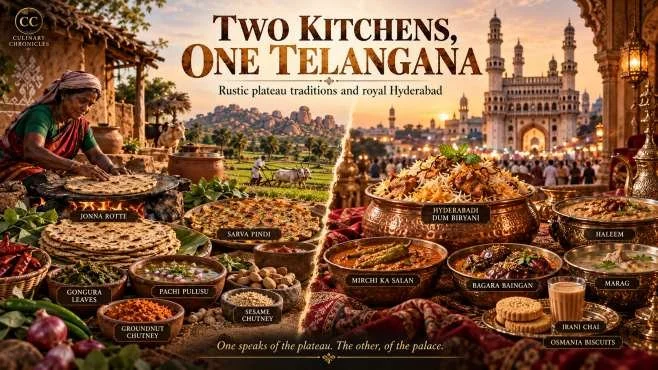
A Tale of Two Kitchens
For me, the most fascinating aspect of Telangana is the coexistence of its rural and royal culinary traditions. In one kitchen, a farmer prepares a millet bread over a hot griddle, accompanied by chutney and a seasonal vegetable.
In another, a cook carefully seals a handi of rice and meat, allowing spices and aromatics to slowly develop their flavours.
One tradition emerged from agricultural necessity and local resourcefulness.
The other evolved through royal patronage, cultural exchange and sophisticated culinary craftsmanship.
Yet both celebrate the same fundamental idea: transforming available ingredients into food that carries identity, memory and meaning.
It would be tempting to describe one as humble and the other as grand.
But that would miss the point.
There is considerable sophistication in knowing how to make a satisfying meal from millet, tamarind and a handful of chillies. Just as there is remarkable skill in achieving the perfect balance of a Dum Biryani.
Different techniques. Different histories. Equal culinary dignity.
The Last Morsel
Telangana teaches us that a region’s cuisine cannot be understood merely by identifying its most famous restaurant or celebrated dish.
Its food is a record of its landscape, rivers, agricultural practices, dynasties, communities, festivals, languages and everyday struggles.
It is also a record of movement: between village and city, Old City and IT corridor, Telugu and Urdu, pan dukan and café, home kitchen and street stall.
The Kakatiya tank is part of that record too. It represents the patient work of capturing seasonal rain, sharing water, sustaining agriculture and turning a difficult plateau into a habitable landscape.
The millet bread speaks of resilience.
The tamarind preparation speaks of ingenuity.
The festive snack speaks of celebration.
The tank speaks of cooperation and foresight.
The biryani speaks of cultural exchange.
And the slow-cooked Ramadan dish speaks of patience, community and tradition.
Together, they remind us that food is perhaps one of the most accessible ways of understanding a people and their history.
So the next time someone mentions Telangana and you immediately think of Hyderabadi Biryani, by all means, enjoy it.
But remember to travel a little beyond the royal handi.
Walk through a street-food lane. Listen to the Telugu spoken at a tea stall. Notice the pan dukan glowing beneath its signboard. Watch office workers hurry through the IT corridor. Visit an old tank and imagine the monsoon water moving from catchment to reservoir, from upper tank to lower tank, and finally into the fields that fed generations.
Taste the food of a village kitchen, a festival, a roadside cart and an Irani café.
You might discover that Telangana’s greatest culinary story is not one dish but the conversation between many worlds — and the water systems that made those worlds possible.
Because in Telangana, the Deccan is not merely a geographical plateau. It is a delicious meeting ground of land, culture, language, water, history and appetite.
And every plate has a story.