
HERBS & LEAVES · 09
AMARANTH LEAVES
The Ancient Green
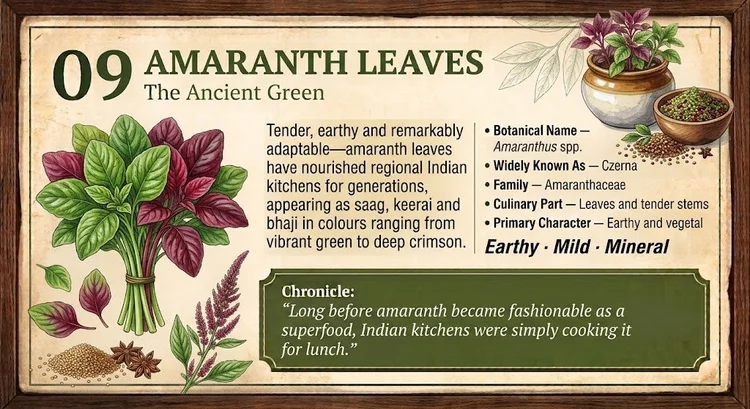
THE LEAF
Amaranth is not one single leafy vegetable.
The genus Amaranthus contains numerous species, several cultivated or gathered for edible leaves.
Across India they appear in colours from bright green to burgundy, crimson and purple.
The leaves are tender when young, with a mild earthy character.
Unlike highly aromatic herbs, amaranth is primarily a cooking green.
NAMES ACROSS INDIA
English — Amaranth Leaves / Amaranth Greens
Hindi — Chaulai
Telugu — Thotakura
Tamil — Arai Keerai / Mulai Keerai
Malayalam — Cheera
Kannada — Dantina Soppu / Harive Soppu
Marathi — Math / Lal Math
Gujarati — Tandaljo
Bengali — Notey Shaak / Lal Shak
Konkani / Goa — Tambdi Bhaji
ORIGIN & JOURNEY
The wider amaranth family has an ancient and geographically complex history.
Different species occur and have been cultivated across different parts of the world.
Leaf amaranths became deeply established within Indian agricultural and culinary traditions.
Their story is often:
field → market → kitchen → everyday meal.
WHERE INDIA USES IT
Across Andhra Pradesh, Telangana, Kerala, Tamil Nadu, Karnataka, Maharashtra, Goa, eastern India and elsewhere.
IN THE KITCHEN
Amaranth leaves may be:
sautéed
cooked with dal
combined with pulses
cooked with garlic and chilli
prepared with coconut
incorporated into mixed greens
cooked with onions and spices
Tender stems can also be used depending on variety and preparation.
SIGNATURE PREPARATIONS
Thotakura Pappu
Thotakura Vepudu
Cheera Thoran
Tamil Keerai preparations
Lal Math Bhaji
Tambdi Bhaji
Lal Shak
FLAVOUR & AROMA
Generally mild, earthy and vegetal, sometimes carrying a faint mineral character.
Garlic can lead.
Chilli can sharpen it.
Coconut can soften it.
Dal can give it body.
CULTURE & TRADITION
The world notices glamorous dishes first.
A bowl of everyday leafy greens usually does not travel as easily.
Yet humble greens reveal seasonality, local agriculture, affordability and household cooking.
THE CODEX NOTE
"India was eating amaranth long before anyone thought of putting the word 'superfood' on the packet."
The language changes.
The preparation changes.
Sometimes even the colour changes.
But the idea remains wonderfully ordinary:
Take the greens that grow around you, cook them well, and put lunch on the table.