
CULINARY CHRONICLES · MASALA UNIVERSE · 12

Bhaja Moshla
The Last Word Belongs to the Roast
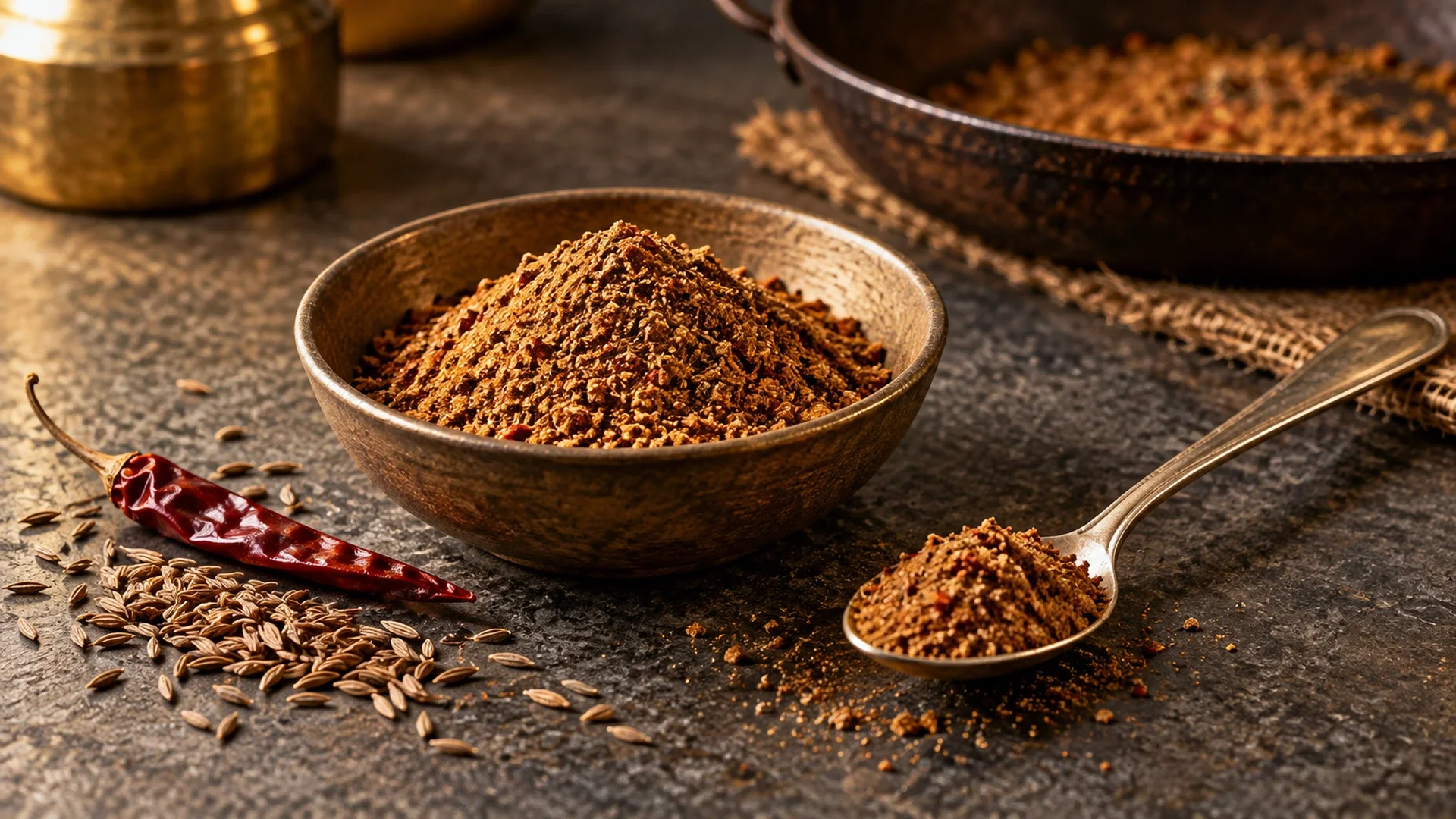
A Finish With Something to Say
Some seasonings are understood best at the moment they are used. Bhaja moshla is one of them: roasted spices, ground and ready to contribute to a dish that already has much of its character. Its interest lies as much in that relationship as in the contents of the grinder.
Bong Eats places its blend in a Bengali repertoire extending from vegetables to ghugni, churmur and phuchka. Debjani Chatterjee Alam describes a much simpler family preparation. [H1, H2] Already the name gives us a subject more interesting than a single mandatory formula.
The roast offers a common point of attention. Beyond that, we must keep the cook in view. A final seasoning can be familiar within a household while taking a different form in another one. The spoonful may be small; the decision behind it need not be.
Ask the Aunt, Then Listen Properly
Food writer Madhushree Basu Roy remembers an aunt whose alur dom finished with bhaja moshla. In her account, the aunt valued its fragrance enough to avoid competing additions. [H3] It is a personal recollection, not a commandment governing every Bengali potato preparation.
What makes the memory useful is the judgement it records. The cook was considering what the seasoning should be allowed to do. Leaving something out could be as deliberate as putting something in. A recipe's character is sometimes easiest to understand through those absences.
Chatterjee Alam also locates her simple version within family practice. [H2] Taken together, the accounts suggest a sensible way to approach culinary inheritance: listen for the reasoning as well as the instructions. Remembering a list is useful. Understanding why a cook keeps the list short, or chooses to lengthen it, gives the next person something more adaptable than obedience.
Several Ways to Keep It Recognisable
Chatterjee Alam's published blend uses cumin and dried red chilli, with cumin alone also described in her family account. Bong Eats combines cumin, fennel, coriander and cardamom. Roy's recipe adds small quantities of other seasonings to a coriander-and-cumin base. [H2, H1, H3]
These are not minor typographical differences. They will lead a cook towards different emphases. Yet each source identifies its preparation as bhaja moshla. The evidence asks us to retain that variety rather than quietly select the most elaborate list and announce that the shorter versions are incomplete.
Consider the practical advantage of a restrained blend. It can contribute something identifiable without being asked to make the whole dish by itself. Complexity has its pleasures too, but it is not a moral achievement measured by the number of jars opened. Sometimes the cook has already made several other decisions before this seasoning is required.
Browned Is Not Burnt
Bong Eats describes an even dry roast over medium-low heat before grinding. [H1] The useful idea is attention through the pan, not a race towards the darkest possible powder. Colour can be a clue, but it is not a prize to be won by keeping everything over the heat for another minute.
Roy likewise cautions against taking the roast so far that bitterness dominates. [H3] A darker photograph is therefore not automatically a more convincing one. The food must look prepared, rather than look as though the photographer needed a stronger contrast against the tabletop.
For a learner, this is a good place to connect the written method with observation. Watch the ingredients, keep them moving and follow the selected recipe's sequence. A grinder can make the result uniform in appearance, but it cannot reverse what happened in the pan. The flavour has already acquired part of its character before the lid goes on.
A Name With More Than One Household Behind It
The difference between the sources is itself valuable evidence. Chatterjee Alam argues for a simple blend suited to her family's dishes; Bong Eats offers a broader aromatic selection. [H2, H1] Rather than make one account correct by declaring another mistaken, we can ask what each preparation is intended to accompany.
That question also helps distinguish bhaja moshla from neighbouring blends. Roy discusses avoiding a garam-masala-like emphasis in her own household's version. [H3] The distinction belongs to a cook's flavour judgement, not to a universal legal definition of which spices may enter which jar.
Keep those attributions attached and the apparent contradiction becomes informative. Different cooks are protecting different relationships between food and seasoning. A living tradition can contain such disagreements. An archive should be able to contain them too, without turning every difference into a verdict or every shared name into proof of identical practice.
More Than One Kind of Last Spoonful
Roy describes uses in cutlets and drinks as well as finishing cooked dishes. [H3] This range is a useful reminder that a roasted seasoning's place is not determined solely by whether the food is served from a saucepan. The intended balance of the preparation matters more than the category on a menu.
Chatterjee Alam lists ghugni, aloor dum, mochar ghonto and chutney among the destinations for her version. [H2] The powder's modest scale makes sense in that context. It joins an existing dish rather than asking every dish to become a demonstration of the spice blend.
Begin with one source's blend and one of its documented uses. Notice how much is asked for and when. The idea is to learn a relationship, not to establish a compulsory finishing sprinkle for everything labelled Bengali. A seasoning becomes useful when we know where its contribution belongs, including when enough has already been added.
The Dish Gets Its Last Word
Cumin, coriander, chilli, fennel and cardamom offer Spice Codex reading paths according to the selected formula. Their presence in this article does not make them all compulsory in one bhaja moshla. The simpler and more expansive accounts retain their separate voices.
Roy's recollection of bhaja moshla finishing alur dom brings the discussion back to the end of cooking. [H3] By then the dish already has a character. A roasted seasoning can give it another emphasis; how much to add depends on the food receiving it. That final addition is a conversation with what is already in the pan.
Roasting and finishing belong together in this story: one prepares the flavour, the other finds its place. A little can make the dish feel complete; more is not an automatic improvement. Bhaja moshla leaves us listening for that last note, when a familiar Bengali preparation comes into focus and the spoon can finally rest.
Sources and Further Reading
Spice Codex reading links
Source register
- H1 — Bhaja Moshla — Bong Eats. 21 July 2017. Locators: introduction; ingredients; method; listed uses. Accessed 2026-10-09.
- H2 — Bengali Bhaja Moshla Recipe - the basic blend — Debjani Chatterjee Alam. 10 November 2023, updated 22 October 2024. Locators: Debjani's Note; ingredients; method; family attribution; uses. Accessed 2026-10-09.
- H3 — Bhaja Masala | Bhaja Moshla | Bengali Roasted Spice Mix — Madhushree Basu Roy. 12 May 2020. Locators: aunt's account; variations; uses; roasting discussion; recipe card. Accessed 2026-10-09.