
CULINARY CHRONICLES · MASALA UNIVERSE · 11

Dhana-Jeeru Powder
Two Seeds and the Work of an Everyday Kitchen
A Short List Can Still Have Character
Two ingredients do not sound like much of a universe. Coriander and cumin might even seem too familiar to require an introduction. Yet dhana-jeeru powder makes a good case for looking closely at preparations that do their work without demanding applause. A blend need not be complicated to carry a recognisable cooking habit.
Puja of Indiaphile identifies dhana jiru as the name used in her household for a toasted coriander-and-cumin mixture in Gujarati cooking. Shilpa Joshi likewise records dhana jiru and dhana jeeru among its Gujarati names. [D1, D3] The title already tells us who the principal participants are.
What it does not tell us is their balance, how they were prepared or what the cook expects of them. A short ingredient list leaves fewer places for those decisions to hide. Simplicity, in this kitchen, still asks us to pay attention.
The Pantry Can Travel
Puja recalls her mother preparing the mixture for her during college, with a small working quantity and the rest kept separately. [D1] It is a specific personal memory, offered by its owner. There is no need to borrow it as somebody else's childhood to understand its significance.
A prepared seasoning can make familiar cooking easier away from the kitchen where it was learned. That is the human possibility suggested by the account: practical help carried in a form that another person can use. The gift contains some work already completed, leaving enough work for the recipient to make a meal of their own.
Mayuri Patel's published recollections of helping her mother prepare spices offer another domestic perspective. [D2] Such memories are not a chronology of the blend's invention. They are records of attention and participation. Sometimes culinary continuity looks less like a guarded secret and more like being allowed to help, then being trusted with the jar.
Ratios Need Their Units
Puja's recipe uses half a cup of coriander to a quarter cup of cumin. Patel's uses two cups of coriander to half a cup of cumin. Joshi gives one cup of coriander to half a cup of cumin. These are volume measures: respectively 2:1, 4:1 and 2:1 in the published recipes. [D1, D2, D3]
That distinction is worth making explicit. “Two to one” is incomplete until we know what is being measured. A cup comparison must not silently become a weight comparison, especially when two differently shaped seeds are involved. Precision here serves the cook rather than turning lunch into a mathematics examination.
The formulas give a learner actual choices to compare. More importantly, they show why a familiar name need not predict a fixed balance. Choosing a recipe means choosing an emphasis. Two seeds are sufficient to make that choice perceptible, and sufficient to make a household's preparation worth describing accurately.
Separate Turns in the Pan
Patel roasts coriander and cumin separately over low heat, cools them and grinds them to her preferred texture, between coarse and fine. [D2] The plainness of the method should not obscure the observation it requires. Each seed gets its own turn rather than being expected to finish on the other's timetable.
There is something reassuringly practical about learning a blend with so few moving parts. The learner can notice what changed in the pan and then connect that change to the finished powder. Add ten more ingredients and that connection can become harder to follow.
Joshi presents home preparation as a convenient part of keeping a working spice box. [D3] The grinder may shorten the physical task, but it does not remove the cook's responsibility to choose the roast and texture. Equipment can make the work easier without making judgement redundant. Even two ingredients have not agreed to cook themselves.
Familiar Does Not Mean Identical
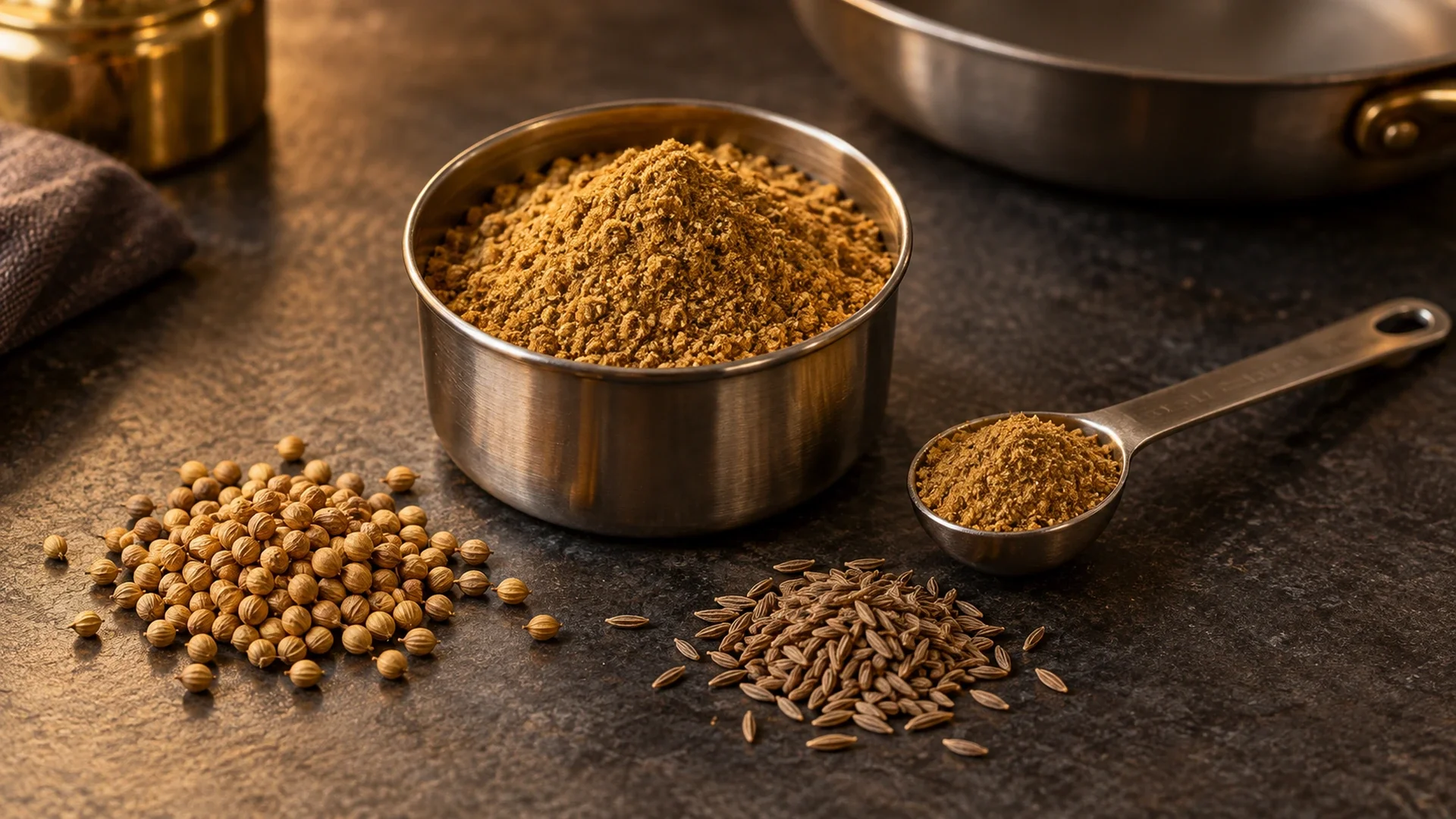
Patel notes that some versions include turmeric; her own ingredient list contains only the two seeds. [D2] That small distinction matters when we describe the powder or plan an image. A photograph of a vivid yellow blend would suggest a choice that her published formula has not made.
The proportions already provide another axis of variation. There is no reason to turn the recipes into a competition for the one correct Gujarati ratio. Their value lies partly in showing named cooks making different decisions within a recognisable preparation.
Nor should we draw a state boundary around the ingredients themselves. Coriander and cumin have uses beyond this blend. The particularity lies in preparing them together, naming the preparation and using it within a repertoire. Culinary identity does not require exclusive ownership of the shopping list. It can live in the ordinary, repeated relationship between a jar and the dishes for which it is reached.
Useful Enough to Keep Nearby
Puja points to shaaks including stuffed okra and a brinjal-and-pigeon-pea preparation among her uses for dhana jiru. [D1] These examples give the powder a life beyond the photograph of two seeds. It belongs to meals whose other ingredients and methods remain important.
The convenience is easy to understand: two seasonings are already brought together in a familiar balance. But convenience does not mean universality. Reaching for a prepared mixture in one recipe does not imply that separately measured coriander and cumin have become unnecessary everywhere else.
For a new cook, that is a useful distinction to learn early. Follow the preparation named in the recipe and notice when the mixture is added. If another dish asks for whole seeds, the powder is not automatically an equivalent. The cupboard can hold both forms without a philosophical crisis. They simply answer different questions at the stove.
Familiar Enough to Be Overlooked
The Spice Codex gives coriander and cumin their separate stories. Dhana-jeeru brings them back together in a preparation whose short ingredient list makes it easy to underestimate. There is no procession of rare aromatics here, and no need to apologise for their absence.
Puja's shaaks give the mixture a Gujarati setting: stuffed okra, brinjal and pigeon peas are among her documented uses. [D1] The attraction is the familiarity of the pairing within that repertoire. Two everyday seeds can belong comfortably beside other ingredients without making each meal an exhibition of spice.
The different ratios described here leave plenty for cooks to discuss, but the blend's modesty deserves a little affection too. Not every useful jar needs a secret ingredient. Sometimes coriander and cumin are quite sufficient company. The cupboard would be poorer if we noticed only the preparations with the longest shopping lists.
Sources and Further Reading
Spice Codex reading links
Source register
- D1 — Dhana Jeera | Dhana Jiru | Cumin Coriander Powder — Puja, as displayed byline. 26 February 2023. Locators: introduction; Using Dhana Jeera; family account; recipe measures. Accessed 2026-10-09.
- D2 — Dhana Jiru/Coriander Cumin Spice Powder — Mayuri Patel. 13 April 2020. Locators: personal recollection; recipe card; turmeric note; method. Accessed 2026-10-09.
- D3 — Cumin Coriander Powder — Shilpa Joshi. 16 June 2022, updated 30 January 2024. Locators: Gujarati names; spice-box discussion; recipe card. Accessed 2026-10-09.