
CULINARY CHRONICLES · MASALA UNIVERSE · 10

Kashmiri Ver / Vaer
A Seasoning Held Together by More Than Spice
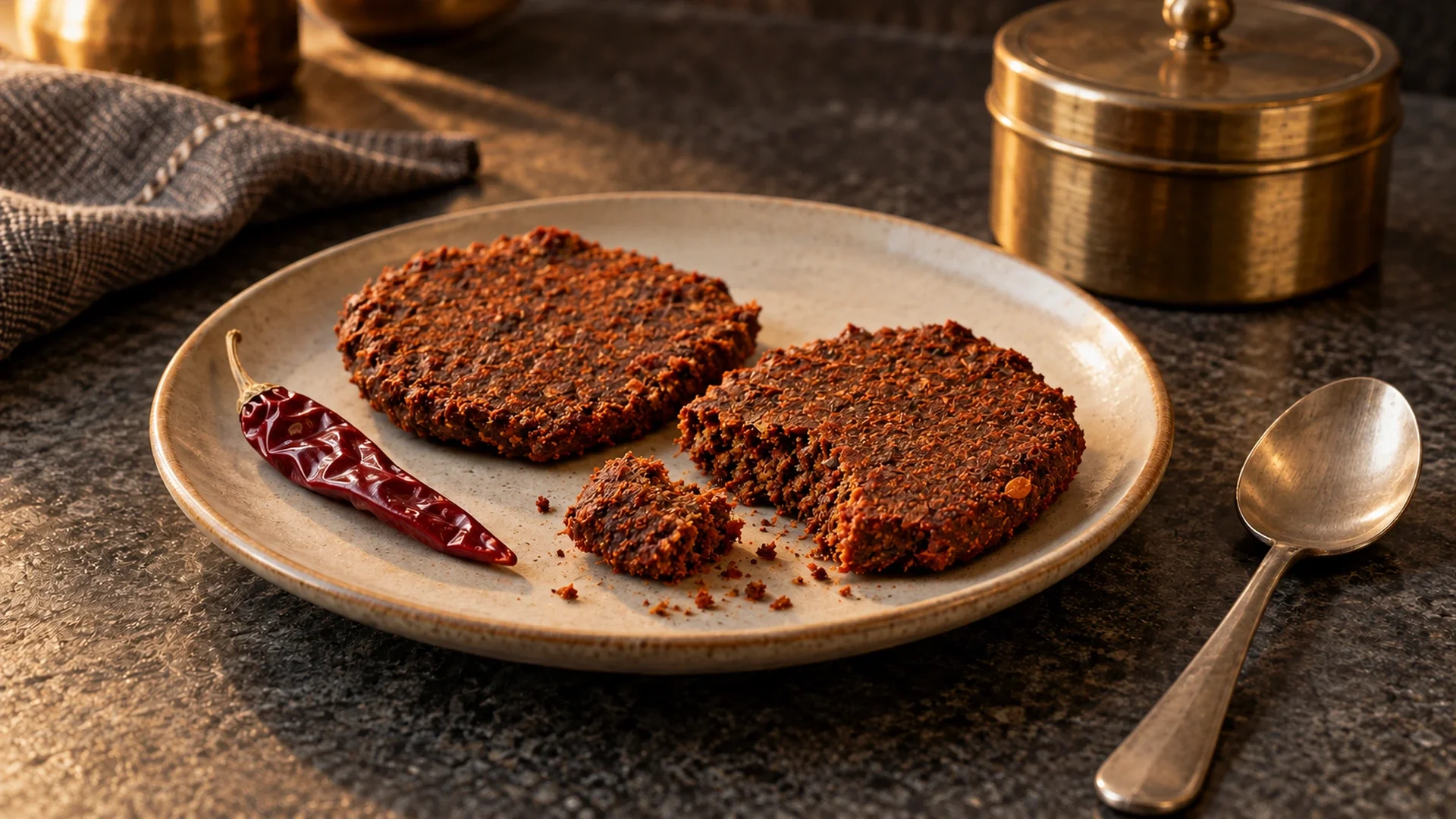
Break a Little, Understand a Little More
A spice blend need not arrive as a loose powder. Kashmiri ver, also written vaer, asks us to consider the cake: seasoning brought together, shaped and dried, then broken for use. It is a different way of making something ready, with the preparation's physical form carrying part of its meaning.
Chef Nalini Moti Sadhu's account, scripted by Priyanka Bhardwaj for Kanz & Muhul, describes crushing a small piece towards the end of cooking. [V1] The gesture is wonderfully economical. A preparation that required attention earlier is made useful in a few movements now.
The cake is not a decorative curiosity beside an otherwise familiar masala. It changes what the cook handles and how the seasoning is portioned. To understand ver, begin with that small act of breaking, then follow it back towards the work that made the piece possible.
A Cake Among the Winter Stores
In her 2011 Kashmir Life report on changing winter life, Aliya Bashir records accounts of stocking food for the cold months. Hameeda, a woman described as drying vegetables for winter, also recalls vaer among those foods. [V5] This is a particular recollection within a reported seasonal setting, rather than an account of the spice cake's invention.
The work of making the cake is more directly visible in Reena Moza's recipe: mixing, kneading, resting, forming and drying are distinct stages. [V3] Read beside Bashir's report, the method gives the stored preparation a human scale. The convenient piece at cooking time has already asked for attention elsewhere.
That labour deserves a place in the story without our deciding who must have performed it in every household. A finished cake shows little of the effort behind its shape. Looking back through the method makes that effort visible: not a romantic flourish added to the meal, but part of how the seasoning came to be ready.
The Binding Is Part of the Blend
Reena Moza's published tikki recipe combines powdered spices with urad flour, asafoetida water and oil, preferably mustard oil, before shaping and drying. Fennel and dried ginger sit alongside chilli and a broader aromatic selection. [V3] Here the ingredients do more than contribute separate flavours; the preparation has to come together physically.
Anita Tikoo, in a recipe published by Rohan Kamicheril, likewise describes a sun-dried spice cake made with hing, red chilli and other spices in mustard oil. [V4] These accounts help explain why an image of loose red powder would leave something important out.
The choice of binding ingredients also complicates the notion of one universal blend. A cake has a structure as well as a taste. Understanding both is more useful than treating oil, flour or aromatics as incidental details beneath the glamorous list of spices. The apparently modest ingredients may be doing some of the most consequential work.
A Form Made by Hand
Moza describes making a mixture that can be kneaded, rested and flattened into patties before drying. [V3] Those verbs belong to a preparation with a body. The cook is not merely reducing whole spices to smaller particles; the mixture must become something that can be handled and later divided.
Sadhu's account presents another visible form, a ring-shaped cake, and names the mortar and pestle associated with preparation. [V1] A ring and a flattened patty need not become competing badges of authenticity. They are documented forms within a tradition whose practical details deserve to remain visible.
For a reader, the important lesson is to notice sequence and material. Grinding, combining, forming and drying are separate actions. A photograph can suggest the result, but cannot certify how it was made or whether it is ready for storage. Understanding the method requires more than admiring the colour through a screen.
Keep the Speaker in the Kitchen
Sadhu's account distinguishes preparations using garlic and shallots from Pandit versions that omit them. Moza also records an onion-and-garlic variation alongside her flour-bound example. [V1, V3] These sources establish differences in their accounts; they should not be made to legislate the contents of every Kashmiri household's pantry.
Community names are useful when they clarify a documented practice. They become less useful when they are asked to predict every individual cook. A recipe can be rooted in a community without every family having to carry an identical ingredient list as proof of belonging.
Keep the names and the preparations together. Ask which version is being described, which ingredients bind it and how it is used. The differences then become part of the story rather than awkward exceptions. We do not need to smooth them away to recognise a shared culinary tradition; smoothing is precisely what would make the account less revealing.
The Cake Has a Vegetable Life Too
Tikoo's winter-vegetable preparation uses veri masala alongside ingredients including lotus root, radish and potato. [V4] It is a useful corrective to an archive in which Kashmiri seasoning appears only beside meat. The particular recipe gives the blend a clear destination without making it compulsory in every vegetable dish.
Sadhu mentions red gravies, including rajma and rogan josh, as places where a small addition can contribute. [V1] The cook still has to consider the dish already in progress. Ver is an addition within a preparation, not an instruction to replace every other seasoning with a larger piece of cake.
Read these applications together and the physical form becomes less exotic and more practical. The cake can be portioned for different meals. Familiarity lies in knowing what a particular piece will do, how strong the household's preparation is and when its contribution is enough.
Knowledge You Can Break Into Pieces
Red chilli, fennel, asafoetida, pepper and cardamom connect to the Spice Codex through the attributed preparations. Dried ginger retains its own culinary form. But the individual ingredients cannot explain the whole cake: its structure also belongs to the account.
Moza's kneading, resting, shaping and drying make that structure tangible; Sadhu's instruction to crumble a piece shows how it becomes useful again. [V3, V1] Between those two moments lies knowledge that an ingredient list cannot fully communicate. Someone must recognise a mixture that will hold together and understand how the finished preparation is to be used.
This is a way of reading ver as culinary knowledge given a physical form. The work is there even when the finished cake looks still. Break off a little for the pot and its shape changes, but the understanding behind that shape continues into the dish. Preserving the tradition means making room for that understanding, as well as keeping the name.
Sources and Further Reading
Spice Codex reading links
Source register
- V1 — Kashmiri Culture, Cuisine & Spice Cakes! — Information by Nalini Moti Sadhu; scripted by Priyanka Bhardwaj. 11 April 2021. Locators: cake description; community comparison; chef's use instructions. Commercial host with named practitioner. Accessed 2026-10-09.
- V3 — Kashmiri Vear Tikki Masala — Reena Moza. Publication date not displayed. Locators: ingredients; method; community variation note. Accessed 2026-10-09.
- V4 — Anita Tikoo's Kashmiri-Style Winter-Vegetable Mix — Rohan Kamicheril, publishing Anita Tikoo's account and recipe. 1 April 2021, updated 2 April. Locators: opening cake description; ingredient list. Accessed 2026-10-09.
- V5 — Changing lifestyle — Aliya Bashir, named in the article introduction; displayed page byline Kashmir Life. 17 January 2011. Locators: winter food-stock discussion; Hameeda’s recollection of vaer (article paragraphs around dried vegetables). Live page opened and inspected 2026-10-10. Reported memories establish the account, not a universal custom or origin date.