
CULINARY CHRONICLES · MASALA UNIVERSE · 09

Bisi Bele Bath Masala
Karnataka in a Bowl of Rice and Dal
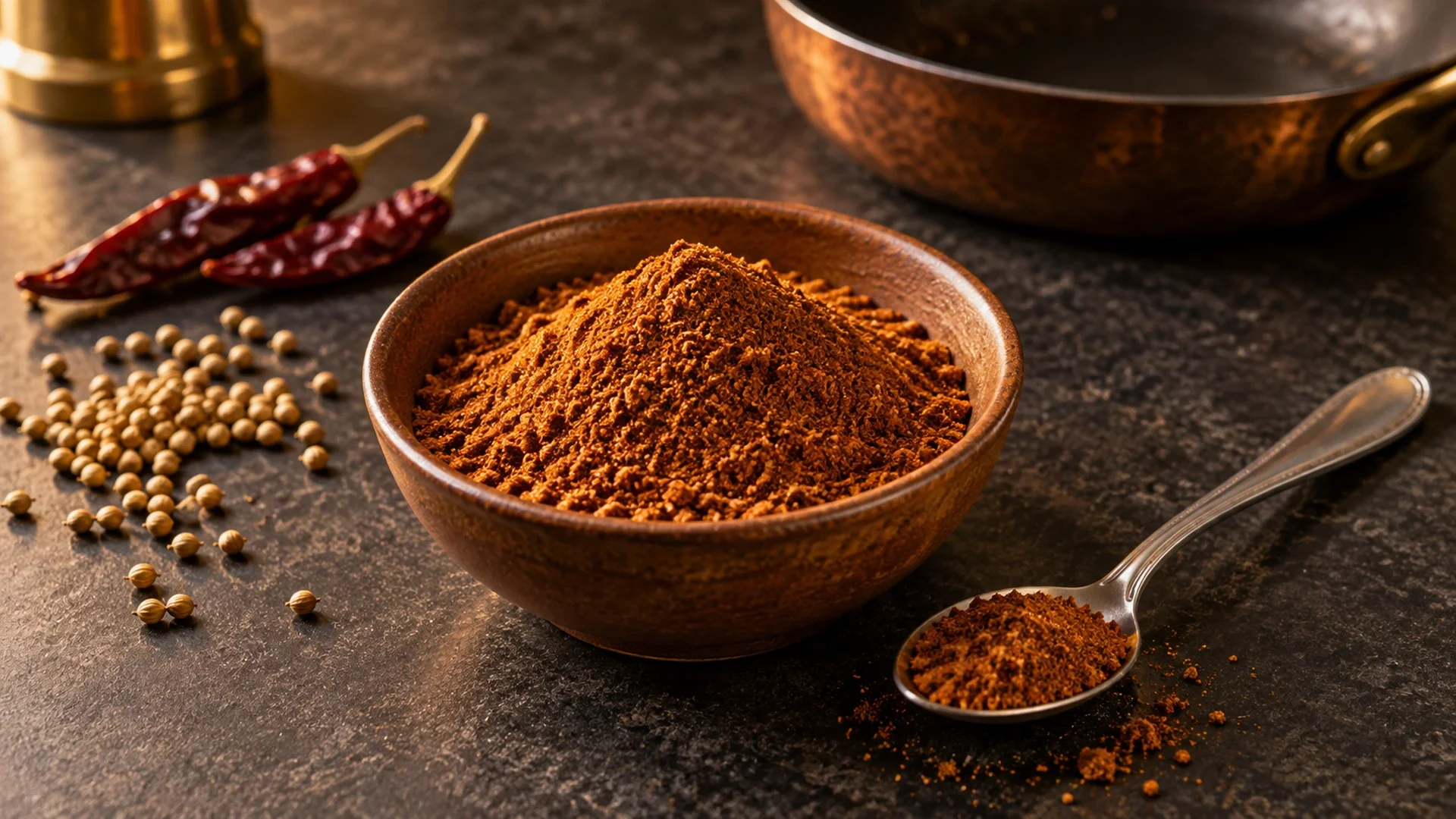
Rice and Lentils Have Somewhere to Go
Rice and lentils can share a pot without becoming the same meal everywhere. Bisi bele bath makes that point rather deliciously. In Karnataka's repertoire, its prepared masala gives the combination a particular direction: the powder is part of what the cook is aiming for, not an emergency handful of whatever happens to be nearby.
Swayampaaka describes the dish as rice, lentils and vegetables cooked with spices and tamarind, and renders its Kannada name as hot lentil rice. [B1] The explanation is modest enough. Yet the words on their own cannot tell us what a familiar bowl should taste like. For that, we need the seasoning and the people who prepare it.
The useful question is not how many other rice dishes it resembles. It is why a cook reaches for this particular jar.
A Mother's Powder, Written Down
Swayampaaka introduces its powder as the author's mother's recipe. [B1] That attribution gives the reader something more valuable than an unspecified promise of authenticity: a preparation with an identifiable domestic source. We can examine what this cook does without asking her to represent every kitchen in Karnataka.
A published household recipe also makes hidden work visible. Before the rice is served, someone has selected ingredients, organised roasting and decided what can be prepared ahead. The finished meal may arrive in a single bowl; the labour does not necessarily happen in one uninterrupted session.
This is one way to understand the masala's usefulness. It gathers repeatable decisions into a preparation that can be used again. That does not establish an origin story, and it need not. A family recipe already offers a human-scale history of practice: someone considered it worth keeping, explaining and passing to another cook.
Warm Aromatics in a Working Blend
Swayampaaka's formula brings coriander and two pulses together with chilli, cinnamon, cloves and other seasonings. It specifies both Byadagi and Guntur chillies. [B1] Two named chillies in one preparation are a reminder that “add chilli” can conceal choices about the character of the finished food.
The Culinary Peace publishes another version with mace and marathi moggu, while treating dried coconut as an optional addition either to the powder or to the dish. [B3] The timing of that coconut matters. Its presence somewhere in a recipe does not necessarily put it inside the stored blend.
Think of the aromatic ingredients as an emphasis within a larger meal, not a licence to make everything taste of cloves. Rice, lentils and the other components still need to be recognisable. A spice blend has done its job when the bowl makes sense, rather than when every ingredient announces its own arrival.
A Sequence Before the Simmer
Hebbars Kitchen dry-roasts its ingredients in groups, roasts dried coconut separately, cools the mixture and grinds it. [B2] The method asks the cook to observe several different materials rather than assume that a pulse, a chilli and a piece of coconut will all be ready at the same instant.
It is worth reading the verbs as carefully as the quantities. Roast, remove, cool and grind are instructions about change. The pan is not merely a waiting room for the mixer. Its work should be completed deliberately, with enough attention left to recognise when fragrance is about to become scorching.
The Culinary Peace likewise separates stages and recommends a small batch or fresh preparation. [B3] This makes a useful starting point for a learner: follow one complete account, notice its cues and record what happened. A recipe becomes more usable through attention, not through doubling every ingredient and declaring economies of scale.
Three Recipes, Three Arrangements
Compare the published formulas and the differences are substantial. Swayampaaka's listed blend has no coconut. Hebbars Kitchen includes it, together with sesame and curry leaves. The Culinary Peace gives coconut a choice of destinations. [B1, B2, B3] No single shopping list can represent these three accounts without changing at least two of them.
That is a reason to retain attribution, not a problem to be solved by finding the winning grandmother. The ingredients can be recognisably related while their arrangement remains a household decision. Even the choice to keep something outside the powder is a meaningful part of the recipe.
The Culinary Peace also explicitly distinguishes bisi bele bath powder from sambar powder. [B3] The comparison is useful because it keeps us attentive to the intended dish. Overlapping ingredients do not make two prepared seasonings identical, any more than two letters addressed to the same city necessarily reach the same person.
The Bowl, Rather Than the Spice List
The principal destination is bisi bele bath itself. The powder belongs in a complete preparation with its own instructions for rice, lentils, sourness and final consistency. Understanding it solely as a dry mixture leaves the most important part of the explanation unfinished.
Hebbars Kitchen also links its powder to an aval version, showing a practitioner adaptation with flattened rice. [B2] Such an example expands the repertoire without obliging us to invent an ancient history for the adaptation. A useful blend can travel while the source of a particular use remains visible.
For a reader beginning here, make the seasoning and the dish from the same attributed account before improvising between versions. This is practical advice, not a border checkpoint. Once the relationship becomes familiar, changing it is a more informed choice. Until then, the powder's name is a helpful promise about the meal, not a substitute for instructions.
A Bowl With a Karnataka Accent
Coriander, cumin, chilli, cloves and fenugreek lead to individual Spice Codex Masters. Here, however, their significance lies in the particular dish they help to make. Swayampaaka's rice-and-lentil preparation and the separately attributed powders give bisi bele bath a clearer identity than the broad label of spiced rice. [B1, B2, B3]
The recipes need not agree on every ingredient for that identity to remain recognisable. Coconut may enter in different places; an aromatic emphasis may change. What holds the comparison together is the meal the cooks name and intend, rather than a requirement that each version match a single master list.
The powder's most persuasive explanation is therefore a bowl of bisi bele bath itself. Rice and dal are familiar ingredients across many cuisines; this preparation asks us to recognise their particular company in Karnataka. The name gets us to the table. The seasoning explains why we wanted this bowl.
Sources and Further Reading
Spice Codex reading links
Source register
- B1 — Bisi Bele Bath Powder | Bisibele bath Recipe | Karnataka recipes — SwayamPaaka. Page displays 20 February 2016 / 10 July 2023. Locators: introduction and mother's-recipe attribution; ingredients; method. Accessed 2026-10-09.
- B2 — bisi bele bath masala powder recipe | karnataka style bisibelebath powder recipe — Hebbars Kitchen. Displayed date 2 February 2019. Locators: ingredients; grouped roasting; aval link. Accessed 2026-10-09.
- B3 — Bisi Bele Bath Powder — theculinarypeace, as displayed byline. 15 September 2019. Locators: sambar comparison; ingredient discussions; optional ingredients; method. Accessed 2026-10-09.