
CULINARY CHRONICLES · MASALA UNIVERSE · 08

Rasam Podi
The Fragrance of Rasam and Rice
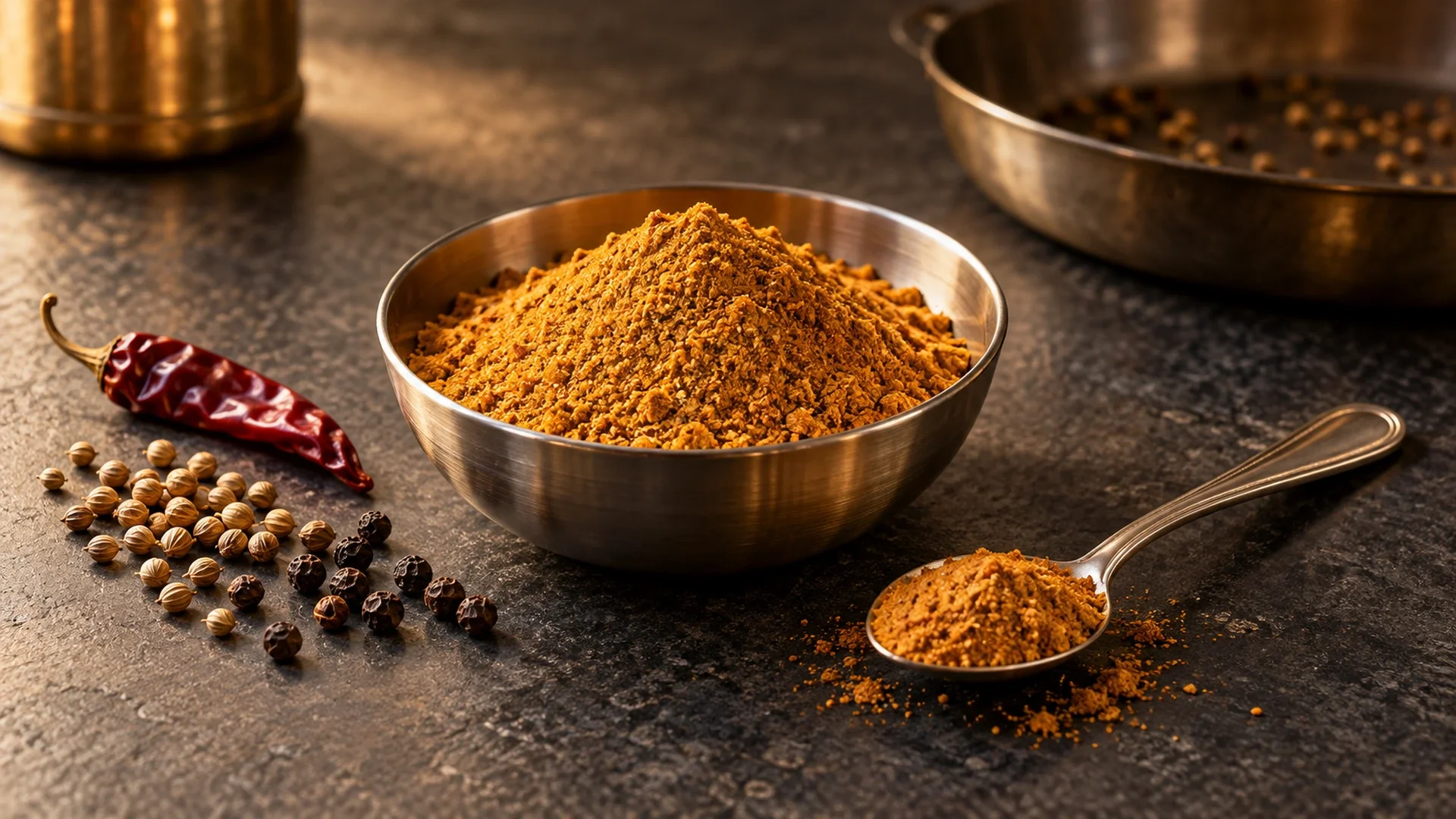
The Jar Is Only the Beginning
There is a particular pleasure in a seasoning that leaves room for the rest of lunch. Rasam podi does not have to make a grand entrance. Its work becomes apparent when a spoonful meets the liquid in the pot: suddenly the meal has direction. The powder is a preparation for another preparation, and understanding that relationship is more useful than counting the spices in the jar.
Raks Anand's everyday rasam combines a prepared powder with tamarind and tomato. Hebbars Kitchen offers an Udupi saaru built around a different balance. Both belong in the conversation, without turning rasam and saaru into interchangeable recipes. A shared family resemblance is an invitation to look more closely, not permission to stop looking. [R2, R4]
Start with the cook's destination. Then ask what has been made ready to get there.
Several Households Behind One Name
Anand's powder article contains a small lesson in domestic diversity. She describes her mother's freshly made seasoning and her mother-in-law's coarser, dal-free version, alongside the recipe she publishes. The differences appear within one family account; no state border is needed to produce them. [R1]
That observation matters when we speak of tradition. A written formula captures a decision, but a cooking practice also includes when the decision is made. Preparing a jar ahead and grinding for today's meal organise work differently. Neither arrangement tells us how deeply a cook cares about lunch.
Think of the powder as time moved from one part of the day to another. That is an interpretation of its practical usefulness, rather than a claim about its invention. The anonymous inventor is not required to make the present-day kitchen interesting. Someone has already considered the next meal before the pot is put on the stove.
Pepper Has Company
The stored blend published by Anand includes coriander, dried chilli, pepper, cumin, toor dal, chana dal and asafoetida. Her ingredient list gives pepper company rather than a monopoly. The result belongs to a particular recipe, not to a rule that every rasam powder must contain pulses. [R1]
It is helpful to separate the seasoning from the finished dish. Tamarind in the pot is not automatically tamarind in the jar. Fresh leaves added during cooking do not prove that the stored powder contains them. The distinction sounds small until an illustration, shopping list or hurried substitution quietly erases it.
The ingredients also suggest different kinds of emphasis. A pepper-forward impression and a chilli-led one are not identical experiences; coriander and cumin bring another aromatic conversation. Proportion is how the cook decides who speaks first. An ingredient list tells us who was invited, but not where everyone will sit.
Watch the Pan, Then the Pot
Anand roasts ingredients in stages, cools them and grinds the stored blend. Her method gives cumin a later turn in the pan. The sequence is part of the recipe's knowledge, rather than an optional preamble to the exciting business of switching on the grinder. [R1]
For a fresh preparation attributed to Pavithra Vijayaraghavan's mother's handwritten notes, Anand records a different sequence, including ghee-roasted ingredients and cumin added at grinding. This is a transmitted recipe with a named route of transmission, not evidence that all earlier kitchens worked this way. [R3]
Once the powder reaches the rasam, attention changes from roasting to cooking time. Anand's everyday method stops soon after the seasoned liquid comes to the boil. [R2] The cook has two opportunities to exercise restraint: first over the pan, then over the pot. Neither is improved by leaving it alone while answering every message on the telephone.
The Map Does Not Fit Inside the Lid
Hebbars Kitchen's Udupi powder uses coconut oil during roasting and includes fenugreek and curry leaves; the accompanying account places tamarind and jaggery prominently in the saaru. It provides a regional practitioner example, not an exhaustive definition of Udupi cooking. [R4]
Another useful boundary appears in Suguna Vinodh's Paruppu Selavu Rasam from Kongunadu. Its freshly ground, water-assisted masala includes vegetables and aromatics as well as spices. That paste belongs to the rasam repertoire, but it is not a stored dry podi. [R5]
These distinctions keep regional names meaningful. Fresh grinding is not simply an old-fashioned stage that every household eventually abandoned, and a jar is not the sole measure of culinary continuity. Different preparations answer different cooking needs. We learn more by retaining those differences than by assembling all their ingredients into an imaginary southern master powder.
Lunch Still Needs a Cook
Anand serves her everyday rasam with hot rice and ghee, with a vegetable accompaniment. [R2] Notice the scale of the meal: the powder contributes to something eaten alongside other things. It does not have to supply every texture, taste and aroma by itself.
This is why a complete recipe is a better introduction than an instruction to add rasam podi “to taste” and hope for ancestral guidance. The amount of liquid, the sour ingredient and the cooking sequence all matter. Learning the powder means learning those relationships, not merely recognising its smell.
For an experienced cook, familiarity can make such decisions look effortless. For someone learning, explanation is a form of hospitality. A measure, a cue at the stove and a clear distinction between powder and tempering can do more than a solemn assurance that this is how it has always been done.
From the Spice Shelf to the Rice
Pepper, cumin, coriander, red chilli and asafoetida each have a place in the Spice Codex; fenugreek enters through the Udupi comparison. Reading them separately helps us notice their different contributions. Returning to rasam reminds us that the powder still needs a meal around it.
In Anand's everyday preparation, tamarind and tomato join the seasoning in the pot, while rice and ghee give the finished rasam its company at the table. [R2] The jar cannot contain that whole relationship. Sourness, liquid, seasoning and the food alongside them belong to the finished meal, with room for the distinct versions described here.
That is rasam podi's particular pleasure: a small quantity can help make a light, aromatic dish without asking it to carry lunch alone. Follow the fragrance beyond the jar and the rice is waiting. The powder makes most sense when there is something to pour.
Sources and Further Reading
Spice Codex reading links
Source register
- R1 — Rasam powder recipe, Homemade rasam powder — Raks Anand. Updated 9 September 2021. Locators: family introduction; recipe card; instructions. Accessed 2026-10-09.
- R2 — Easy Rasam Recipe, How to make rasam | South Indian Basic — Raks Anand. Updated 28 May 2026. Locators: recipe card; serving suggestion. Accessed 2026-10-09.
- R3 — Rasam with fresh ground rasam powder — Raks Anand; recipe attributed to Pavithra Vijayaraghavan's family note. Updated 11 October 2023. Locators: opening attribution; ingredients; instructions. Accessed 2026-10-09.
- R4 — rasam powder recipe | udupi saaru pudi | rasam podi — Hebbars Kitchen. 27 January 2021. Locators: hometown account; step-by-step method. Accessed 2026-10-09.
- R5 — Paruppu Selavu Rasam — Suguna Vinodh. February 2023. Locators: introduction; Selavu Masala Paste; method. Accessed 2026-10-09.