
HERBS & LEAVES · 07
DILL LEAVES
The Feathery Herb
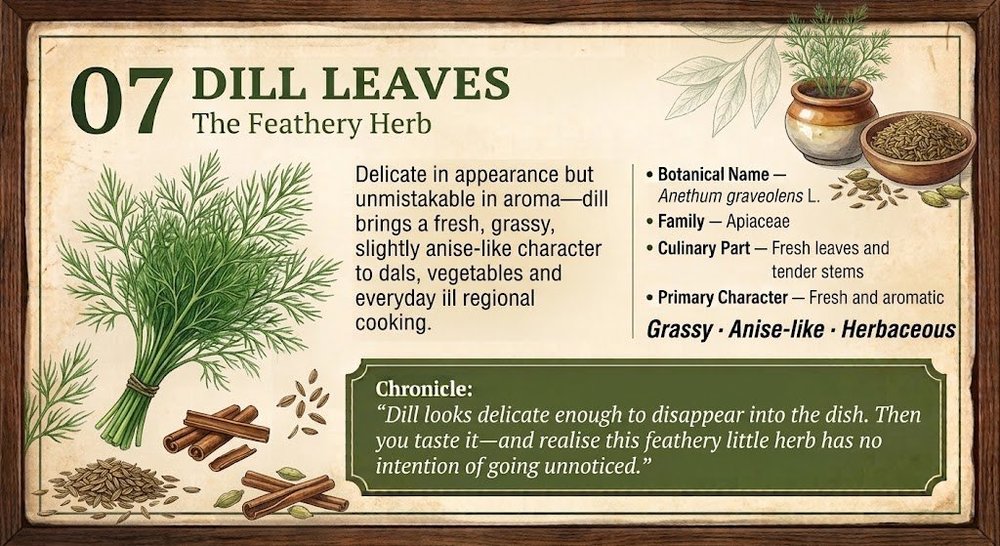
THE LEAF
Dill is almost architectural in appearance.
Its slender stems carry finely divided, feathery leaves that look far more delicate than their aroma suggests.
Botanically, dill belongs to Apiaceae, placing it among relatives such as coriander, cumin and fennel.
It is fresh and grassy but carries a distinctive sweet, slightly anise-like quality.
NAMES ACROSS INDIA
English — Dill
Hindi — Sowa / Suva
Marathi — Shepu
Gujarati — Suva
Kannada — Sabbasige Soppu
Telugu — Soa Kura / Soya Kura
Tamil — Sada Kuppi / Sathakuppai
Bengali — Shulfa / Sowa
Punjabi — Sowa
ORIGIN & JOURNEY
Dill is an ancient aromatic herb with a long history across the Mediterranean, West Asia and adjoining regions.
Once ingredients enter regional kitchens, origin becomes only the first chapter.
Shepu in Maharashtra, Suva in Gujarat and Sabbasige Soppu in Karnataka belong to their own culinary contexts.
WHERE INDIA USES IT
Especially associated with everyday cooking in parts of Maharashtra, Gujarat, Karnataka and North/Central India.
Its strongest stories often live in the home kitchen.
IN THE KITCHEN
Fresh dill may be:
sautéed as a leafy vegetable
combined with lentils
cooked with potatoes
paired with moong dal
incorporated into mixed greens
added to flatbreads
used in rice preparations
SIGNATURE PREPARATIONS
Shepuchi Bhaji
Shepu Moong Dal
Suva Dal
Sabbasige Soppu Palya
Dill with Potatoes
Mixed Greens with Dill
FLAVOUR & AROMA
Fresh, grassy, slightly sweet, herbaceous and gently anise-like.
The leaves look fragile.
The flavour isn't.
CULTURE & TRADITION
Dill demonstrates that India's food culture is much larger than India's restaurant menu.
A bowl of everyday greens may carry considerably more emotional weight than a celebrated restaurant dish.
THE CODEX NOTE
"Dill has the appearance of a supporting actor and the aroma of someone who has already rewritten the script."
Different names.
Different kitchens.
Different preparations.
Yet the same unmistakable fragrance announces its arrival.