
CULINARY CHRONICLES · MASALA UNIVERSE · 01

Garam Masala
The Warmth That Travels Across India
The Last Pinch, the First Impression
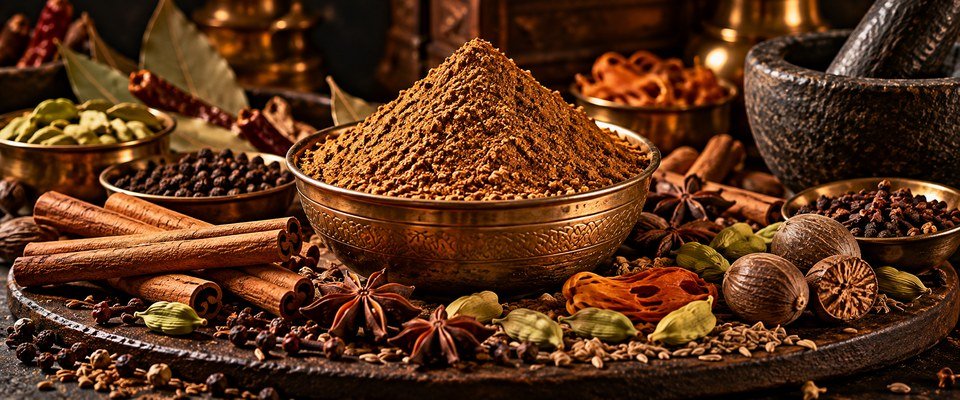
The pot may have been on the stove for an hour. Then comes a small pinch, a stir, and a fragrance that makes you look up. Garam masala can have that sort of entrance: modest in quantity, entirely unembarrassed about being noticed. Its work is often aromatic, although the word ‘warmth’ can tempt us to expect a chilli assault.
Consider the compact Bengali blend documented by Bong Eats: cardamom, cinnamon and cloves. No red chilli. Its broader shahi version does include chilli and pepper, alongside additional aromatics. Warmth and pungency can meet in the same jar, but they are not the same job. [G2, G3]
That distinction opens the door to the whole subject. Garam masala is a family of blends, with different balances and different assignments. To understand the jar, we need to know the kitchen expecting to use it. The name travels; the recipe carries local luggage.
A Jar with More Than One Address
A named blend lets a cook choose several spices together rather than begin the conversation afresh with each pot. We can read it as a practical expression of preference: this much fragrance, that much depth, enough warmth to recognise, and no more than the dish can carry. The important word is choose.
Dassana Amit records an everyday formula and a Punjabi alternative, drawing on her own cooking and family knowledge. That is a useful glimpse of how a familiar name accommodates more than one expectation. The variation does not wait politely outside the definition; it belongs inside it. [G1]
Perhaps our desire for one national recipe tells us more about writing recipes than cooking them. A single list is easy to print. A country of kitchens is less cooperative. Asking what a particular household means by garam masala gives us a better beginning than insisting that everyone should mean the same thing.
Warmth Has Several Voices
Amit’s broader blend gathers cumin, coriander and fennel with pepper, cinnamon, cloves, both cardamoms, bay leaf, nutmeg and mace. Set that beside the Bengali three-spice example and the difference is immediately visible: one offers a larger ensemble, the other a closely arranged trio. [G1, G2]
The contrast invites us to think about proportion before prestige. An ingredient list tells us who is present; the balance tells us who gets to speak. A blend containing many spices need not taste crowded, and a short formula need not taste simple. Complexity is not a head count.
Bong Eats expands its Bengali base in the shahi preparation with spices including nutmeg and mace, as well as pepper and dried chilli. Here, a different aromatic emphasis sits within the same regional repertoire. Even ‘Bengali garam masala’ is too broad a label to promise one unvarying jar. [G3]
Before the Grinder Starts
How the spices reach the grinder matters. Amit describes sun-dried, unroasted and roasted preparations through a family framework, linking that distinction to when the powder enters cooking. Bong Eats dry-roasts its compact blend before grinding. These are recognisable approaches with different histories of use, rather than competing answers to a compulsory examination. [G1, G2]
The university-hosted teaching account describes gently heating spices separately and adding the blend near service to retain aroma. It makes an instructive point about attention: ingredients need not all respond to the same treatment at the same pace. [I1]
For a cook reading a recipe, preparation and application belong together. A powder made for one timing cannot automatically be transplanted into another method and expected to behave identically. The useful question is not simply ‘Have I added garam masala?’ It is ‘What has this particular blend been prepared to do?’
The Recipe That Refuses a Passport Photo
There is a temptation to make regional variation tidy: one northern formula, one Bengali formula, labels attached, work finished. But the sources already resist that arrangement. Amit’s everyday and Punjabi examples differ; Bong Eats offers both a compact and an expanded Bengali blend. A region gives us context, not a sealed container. [G1, G2, G3]
Nor should the presence of chilli settle the matter. The earlier examples show why fragrance and heat need to be considered separately. A hotter blend can still pursue aromatic balance; a blend without chilli can still make its presence felt. ‘Garam’ is not a reliable instruction to reach for a glass of water.
Household formulations become intelligible when we ask about their destinations. Is this jar meant to finish a vegetable dish, accompany ghee, or season a meat curry? The answer helps us understand differences as choices. The search for a single national recipe would erase precisely the information that makes those choices interesting.
Knowing When to Enter the Pot
In Bong Eats’ Bengali account, the blend accompanies meat and egg curries and vegetable preparations including ghonto, dalna and khichuri; some uses pair it with ghee. The same aromatic vocabulary can therefore sit within quite different meals. [G2]
The teaching account emphasises a late addition, while Amit’s family distinction allows timing to follow preparation. Read together, they encourage judgement about the dish and the blend rather than a universal last-minute command. [I1, G1]
This is where a jar stops being a list and becomes a relationship. A cook must decide how much the dish needs, what it already has, and which fragrance should remain at the table. More is not always more generous. A signature becomes difficult to enjoy when it covers the entire page; the same can happen to dinner.
The Ingredients, and the People Holding the Spoon
The Spice Codex connections below let us step out of the blend and examine its individual ingredients. They follow the original pilot’s broader and compact formulas: pepper, cardamoms, cumin, coriander, fennel, clove, cinnamon, bay leaf, nutmeg and mace. The reading list preserves those connections without turning every spice into a requirement. [G1, G2]
Follow an ingredient, then return to the combination. That movement is useful: knowing a spice on its own helps us notice the cook’s decision to place it beside another. The story lies in the arrangement as much as in the inventory.
The warmth that travels across India changes its accent along the way. That is its interest. Behind the jar is someone deciding how the meal should smell when it reaches the people waiting for it. To learn that preference is to learn a little about the household. Sometimes a pinch is enough to introduce us.
At the Edge of the Story
Evidence: G1, G2 and G3 document practitioner formulas; G1’s preparation categories are explicitly family knowledge. I1 provides limited instructional corroboration. The passages about choice, signature, household recognition and culinary relationships are editorial interpretation, not historical findings.
Pending: historical emergence, regional surveys beyond the examined examples, and verification of particular cinnamon/cassia and market-name identities before a recipe is specified. ‘Shahi’ in G3 is not evidence of a named royal inventor. No medicinal claim, fixed shelf life or universal authenticity claim is made. Existing Spice Codex connections are preserved; the expanded G3 example includes red chilli, discussed in the text rather than changing the pilot’s link metadata.
- G1 · Garam Masala Recipe — Dassana Amit. Practitioner recipe and explicitly identified family knowledge. Locator: Ingredients; Two Kinds; Variations. Accessed 2026-10-08.
- G2 · Bengali Garam Masala — Bong Eats. Regional practitioner recipe. Locator: Introduction, ingredients and method. Accessed 2026-10-08.
- I1 · Indian Masalas — Author not identified in retrieved teaching document; hosted by CSJMU Gyan Sanchay. University-hosted instructional material; provenance incomplete. Locator: PDF pages 7 (Garam Masala), 11 (Goda Masala), 13 (Rechado Masala). Accessed 2026-10-08.
- G3 · Shahi Garam Masala — Bong Eats. Regional practitioner recipe, 30 March 2017. Locator: Introduction, ingredients and method. Accessed 2026-10-08.