
CULINARY CHRONICLES · MASALA UNIVERSE · 02

Goda Masala
Maharashtra's Quiet Complexity
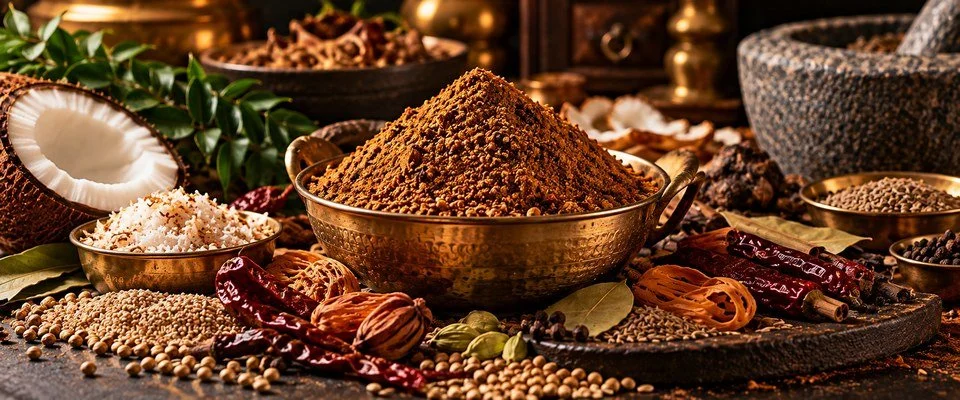
The Fragrance of Taking Your Time
Some masalas make their point with the first sharp bite. Goda asks us to notice the quieter work: ingredients handled separately, the care of roasting, a flavour that has been assembled before the dish even begins. Maharashtra’s complexity can arrive by the spoonful, but someone has already done the patient part.
The practitioner formulas examined here bring coriander together with coconut, sesame and aromatic spices. Dassana Amit describes sweetness in the aroma rather than a sugary taste. The word ‘sweet’ therefore needs a little care: this is seasoning for the meal, not a dessert that has wandered into the wrong cupboard. [D1]
Its character becomes clearer when we look beyond a generic description of ‘Maharashtrian spice powder’. Which cook made it? How were the ingredients treated? What dishes will receive it? Those questions lead us from the jar to the people whose preferences give it a purpose.
The Batch That Goes Home with You
Priya Mani records a summer tradition of large batches prepared by a family matriarch and shared with relatives living elsewhere. She also describes Goda’s place in Maharashtrian Brahmin kitchens. Her account gives us a particular social setting, not exclusive ownership of the masala. [D3]
Think about what a shared batch can do. It carries a chosen balance from one stove to another without asking every recipient to repeat the full preparation. A meal made elsewhere can retain something of the flavour the maker intended. That is how we can read the practice as continuity, as well as useful work.
There is affection in feeding people; there can also be affection in equipping them to feed themselves. In this reading, the jar is a practical gift with an unusually persuasive scent. Its value does not depend on a palace, a ceremonial origin or a legend. The documented family practice is already a story worth staying with.
A Quiet Blend with Plenty to Say
Amit’s recipe uses coriander, cumin, sesame, dried coconut, chilli and stone flower, alongside other aromatics and optional ingredients. The nutty direction of coconut and sesame helps explain why this particular Goda differs from a compact garam masala. Its identity cannot be understood by counting only the familiar warming spices. [D1]
Madhura Bachal’s version has another balance, including black cardamom, star anise, mace and asafoetida; Mani documents a further selection. The recipes show a shared subject with different arrangements. They also remind us to read a formula as a whole rather than lift one ingredient out and declare it the entire secret. [D2, D3]
Quiet need not mean weak. A blend can give a dish depth without making pungency its headline. In that sense, Goda’s complexity asks for a slightly different kind of attention: not ‘How hot is it?’ but ‘What has the cook brought together, and what can I recognise after the first bite?’
One Pan, Several Appointments
The ingredients may eventually share a jar, but they do not have to share the same roasting moment. Amit treats components separately. Bachal distinguishes dry roasting from frying particular spices in a little oil. Their instructions make careful sequence part of the flavour, rather than an inconvenient preamble to grinding. [D1, D2]
Mani describes slow toasting and a finished powder that can look mealy because of its oils. That is a useful correction to the expectation that every homemade blend should resemble a uniformly dry commercial powder. Texture can tell us something about composition and method. [D3]
For the reader, the lesson is attention rather than a new set of universal temperatures. The maker watches the ingredients instead of treating the clock as the only authority. Roasting is work with consequences; hurried preparation cannot be rescued merely by giving the result a beautiful name. The fragrance is earned before it is stored.
Where Goda Meets Kala
The relationship with Kala masala refuses an easy dividing line. Mani records both a variation and an account of regional naming; Amit distinguishes blends in her discussion. Those differences deserve to remain visible. A neat sentence about ‘the darker version’ would settle the question on paper more quickly than the evidence permits. [D3, D1]
For this archive, Goda and Kala retain separate Masters, with their relationship open to further editorial work. That separation allows us to ask whose terminology is being used, which ingredients are present and how the cook applies the blend. It need not imply that every household draws the same boundary.
The same care applies within Goda. Coconut, chilli and the balance of aromatics should be understood in the context of a particular formula. Food terminology lives among people, who have an admirable habit of being more complicated than our filing systems. The archive should make their practices easier to understand, not force them into tidier ones.
The Patient Work Behind an Everyday Spoonful
Amit names amti, masale bhat and stuffed vegetables among Goda’s destinations. Mani’s stuffed-aubergine preparation places the blend alongside other ingredients, rather than treating it as the complete seasoning on its own. [D1, D3]
That is an important practical distinction. A prepared masala can be a foundation or a contribution; the dish still has its own balance to build. The spoonful should be understood in relation to everything else the cook adds, not as an instruction to make every pulse, vegetable and pot of rice taste identical.
Here the earlier labour becomes useful at the everyday stove. Roasting several ingredients has been done in advance; a complex combination is available when the meal needs it. We can read this as a way of concentrating effort without abandoning preference. The jar saves repetition while preserving a particular flavour. Convenience, in this case, need not mean anonymity.
What the Jar Keeps for Us
The Spice Codex links follow the original pilot’s examined formulas. Coriander, cumin, pepper, clove, cinnamon, bay leaf, stone flower and asafoetida are among the connections, with further spices appearing in particular versions. Coconut and sesame matter to the narrative even though they have no Masters in the present 22-Spice register. [D1, D2, D3]
An ingredient archive and a masala archive meet here. One helps us understand the parts; the other asks how a cook makes those parts belong together. The relationship is worth keeping intact, especially when the appeal of a blend lies in more than any single spice can explain.
Return, then, to the family batch in Mani’s account. Someone has taken the time to make a flavour available to others. Our reading of its meaning is simple: culinary continuity can be practical, portable and quietly generous. The jar waits without ceremony. When the next meal begins, the patient work of another kitchen is already there.
At the Edge of the Story
Evidence: D1 and D2 are practitioner recipes. D3 is Priya Mani’s authored handout; its summer-batch and Brahmin-kitchen descriptions remain attributed accounts, not universal or exclusive claims. The reflections on gifting, continuity, convenience and recognition are editorial interpretation.
Pending: wider district and community testimony, historical emergence, Goda/Kala terminology, and botanical/market identification of black cumin, shahi jeera, cassia buds and stone-flower samples. No universal ingredient list, roast colour, fixed recipe ratio or shelf-life claim is prescribed. All original source references and Spice Codex links are retained.
- D1 · Goda Masala Recipe — Dassana Amit. Practitioner recipe. Locator: About Goda Masala; ingredients; roasting method. Accessed 2026-10-08.
- D2 · Goda Masala Latest – Marathi Recipe — Madhura Bachal / Madhura’s Recipe. Regional practitioner recipe, 13 April 2017. Locator: Ingredients and instructions. Accessed 2026-10-08.
- D3 · Recipes with Stone Flower — Priya Mani. Authored culinary handout, copyright 2022; hosted by Culinary Historians of Chicago. Locator: PDF page 2: Goda Masala; page 3: stuffed aubergines. Accessed 2026-10-08.