
Episode 01 / Idli
Who Told the Batter to Wait Eight Hours?
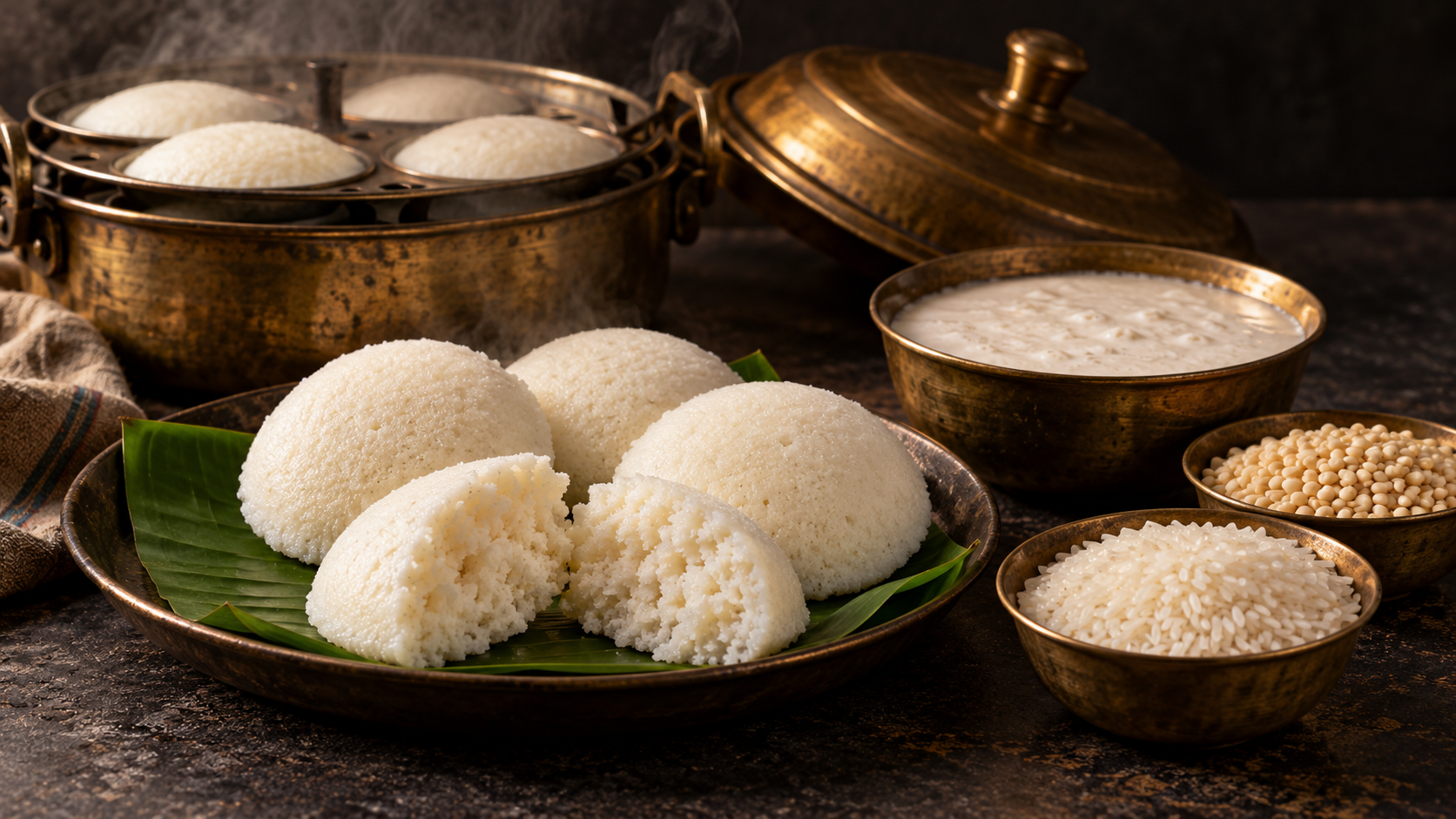
The Curious Thought
Imagine somebody looking at rice and urad dal and deciding that neither of them was particularly interesting alone.
Then deciding the solution was not merely to combine them — but to soak, grind, mix, abandon them overnight and see what happened.
How on Earth Did This Happen?
I sometimes wonder how the idli came about.
What signals of the universe conspired to bring together rice and urad dal?
First soak them.
Separately, naturally.
Then grind them.
Separately again.
Now decide upon a ratio.
Mix them together.
And instead of cooking immediately like any reasonable hungry person, somebody apparently said:
“No. We wait.”
For eight hours.
Perhaps longer.
Until the batter rises, develops bubbles and begins behaving suspiciously alive.
Then comes another leap of faith.
What should we do with it?
Fry it?
No.
Bake it?
No.
Roast it?
Certainly not.
Steam it.
And out emerges a soft, white, spongy little flying saucer.
No crust.
No dramatic colour.
No obvious spice.
Yet somehow destined to conquer breakfast tables around the world.
Then comes the greater mystery.
At what point did coconut chutney look at idli and whisper:
“You need me.”
And when did sambar enter the conversation and announce:
“Actually, both of you need me.”
Somewhere in history rice, urad dal, fermentation, steam, coconut, lentils, tamarind and spices decided to form a permanent alliance.
The idli looks simple.
But behind that innocent little white disc is agriculture, microbiology, fermentation, patience and generations of observation.
What History Says
The history of idli is older and more complicated than the modern dish suggests.
Early Kannada literature provides some of the oldest known references. Vaddaradhane, dating to around the 10th century, mentions iddalige, while later medieval South Indian texts refer to related black-gram preparations.
However, these early versions do not appear to have been identical to today's fermented rice-and-urad idli.
Food historian K. T. Achaya proposed that techniques involving fermentation and steaming may have been influenced by historical connections between South India and Southeast Asia, particularly Indonesia. The theory is interesting but remains debated.
Another possibility is that idli simply evolved gradually within South India: black gram preparations changing over generations as rice, fermentation and steaming became integrated into the technique.
So there may never have been one dramatic moment when someone “invented” idli.
It may instead represent centuries of kitchens quietly improving an idea.
The Last Bite
Perhaps no single person invented idli.
Maybe generations did.
Which makes it even more remarkable.
Sometimes civilizations advance not with a bang, but with somebody asking: “What happens if we leave this batter overnight?”