
Episode 02 / Dosa
Who Decided Batter Needed Geometry?
The Curious Thought
So rice and urad dal have successfully fermented.
Wonderful.
But apparently steaming the batter wasn't enough.
Someone now wants to pour it on hot metal and draw circles with it.
How on Earth Did This Happen?
Imagine someone looking at rice and urad dal and thinking:
“These two should meet.”
But not casually.
Soak them separately.
Grind them separately.
Decide on a ratio.
Combine them.
Then say:
“We wait.”
Again.
Hours later the batter has fermented.
Now comes the difficult bit.
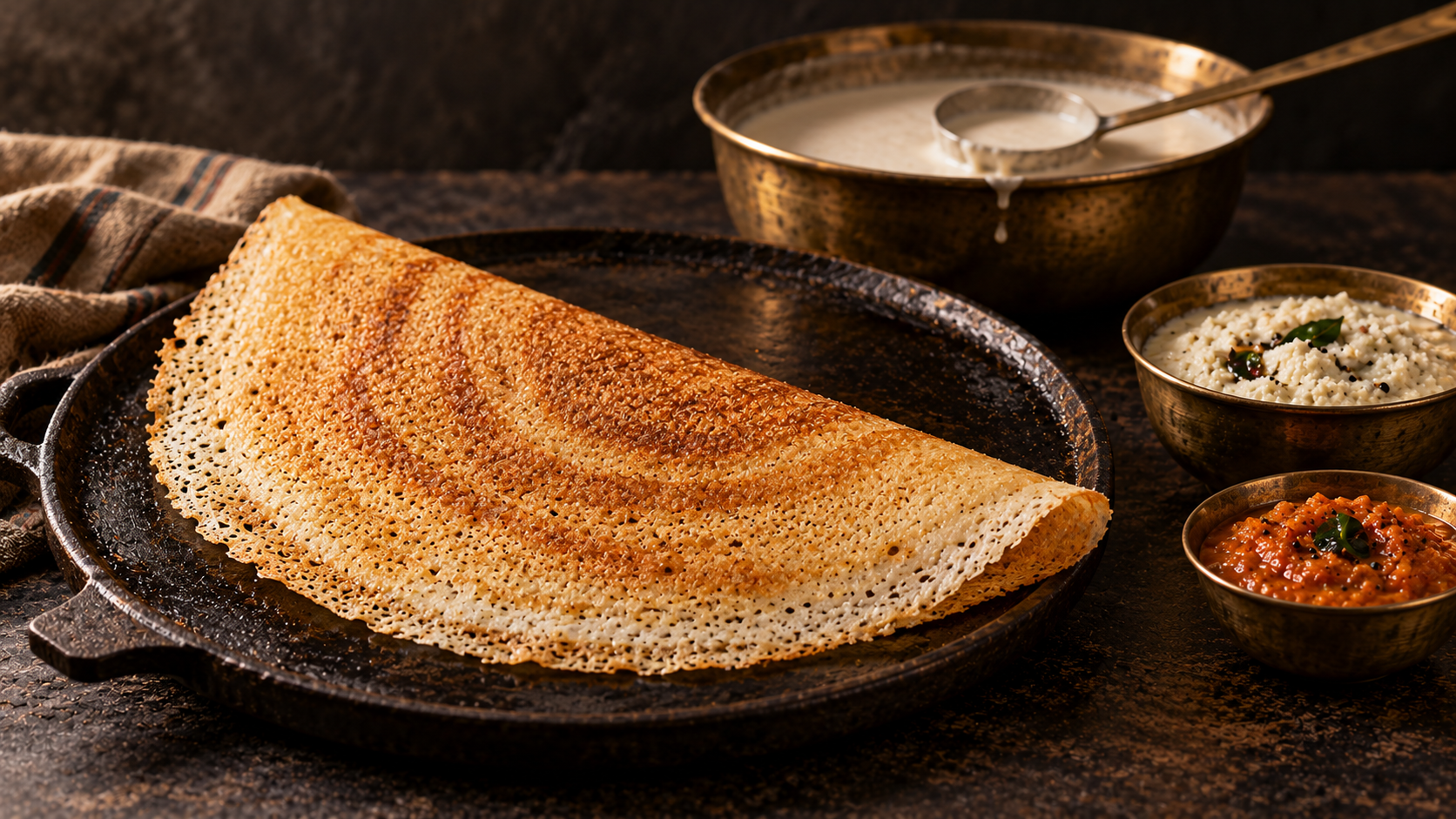
Pour one ladleful onto a screaming-hot tawa.
Quickly spread it before it sets.
Round and round and round.
Too thick in the middle?
Spread faster.
Too thin?
Congratulations, you now have lace.
Add just enough grease so that it neither sticks nor develops resentment.
And suddenly one fermented batter acquires multiple personalities.
Soft dosa.
Crisp dosa.
Paper dosa.
Set dosa.
Masala dosa.
Onion dosa.
Ghee roast.
Stuff it.
Top it.
Fold it.
Roll it.
Make it three feet long and carry it through the restaurant as though someone has ordered construction material.
And then, naturally, serve it with chutney and sambar.
Which raises the important diplomatic question:
Did idli introduce dosa to chutney and sambar?
Or did dosa already know them?
Who borrowed whose friends?
Whatever happened, South India eventually created the culinary equivalent of a highly successful joint venture.
What History Says
Dosa has a long South Indian history, although—as with idli—the exact form of the earliest versions remains difficult to establish.
Ancient and medieval South Indian literature contains references to preparations resembling dosa, particularly in Tamil and Kannada culinary traditions. Historians disagree about whether its earliest recognizable form developed primarily in present-day Tamil Nadu or Karnataka.
The modern dosa emerged through the evolution of fermented grain-and-pulse batters and increasingly refined griddle techniques.
Its characteristic crispness comes from spreading fermented batter thinly over a hot surface, allowing moisture to evaporate while starches and proteins form the delicate browned structure.
The familiar combination of dosa, coconut chutney and sambar developed as part of a wider South Indian culinary ecosystem rather than necessarily through one documented moment of pairing.
So we probably cannot determine whether idli lent dosa its accompaniments—or the other way around.
The Last Bite
Perhaps idli and dosa never borrowed from each other.
They simply grew up in the same neighbourhood.
One chose steam. The other chose geometry. Both chose excellent friends.