
Episode 10 / Karimeen Pollichathu
When Kerala Invented Edible Packaging
The Curious Thought
I have spices.
I have backwaters.
I have banana plants.
Surely all three were not placed in Kerala merely for scenery.
Somebody had to connect the dots.
How on Earth Did This Happen?
Imagine standing beside the backwaters around Kumarakom or Vembanad.
There is Karimeen—pearl spot—swimming around peacefully.
There are banana plants everywhere.
And Kerala possesses enough spices to make subtlety entirely optional.
What do you do?
Obviously something drastic.
Catch the fish.
Now create a masala.
Chilli.
Turmeric.
Pepper.
Ginger.
Garlic.
Shallots.
Perhaps tomato.
Curry leaves.
Coconut oil.
Coat the fish generously.
But ordinary frying would be disappointingly straightforward.
Then somebody remembers:
“Don't the Parsis wrap fish in leaves?”
Interesting.
But Kerala does not borrow quietly.
Take the Karimeen.
Smother it in masala.
Place it inside a banana leaf.
Wrap it.
Seal it.
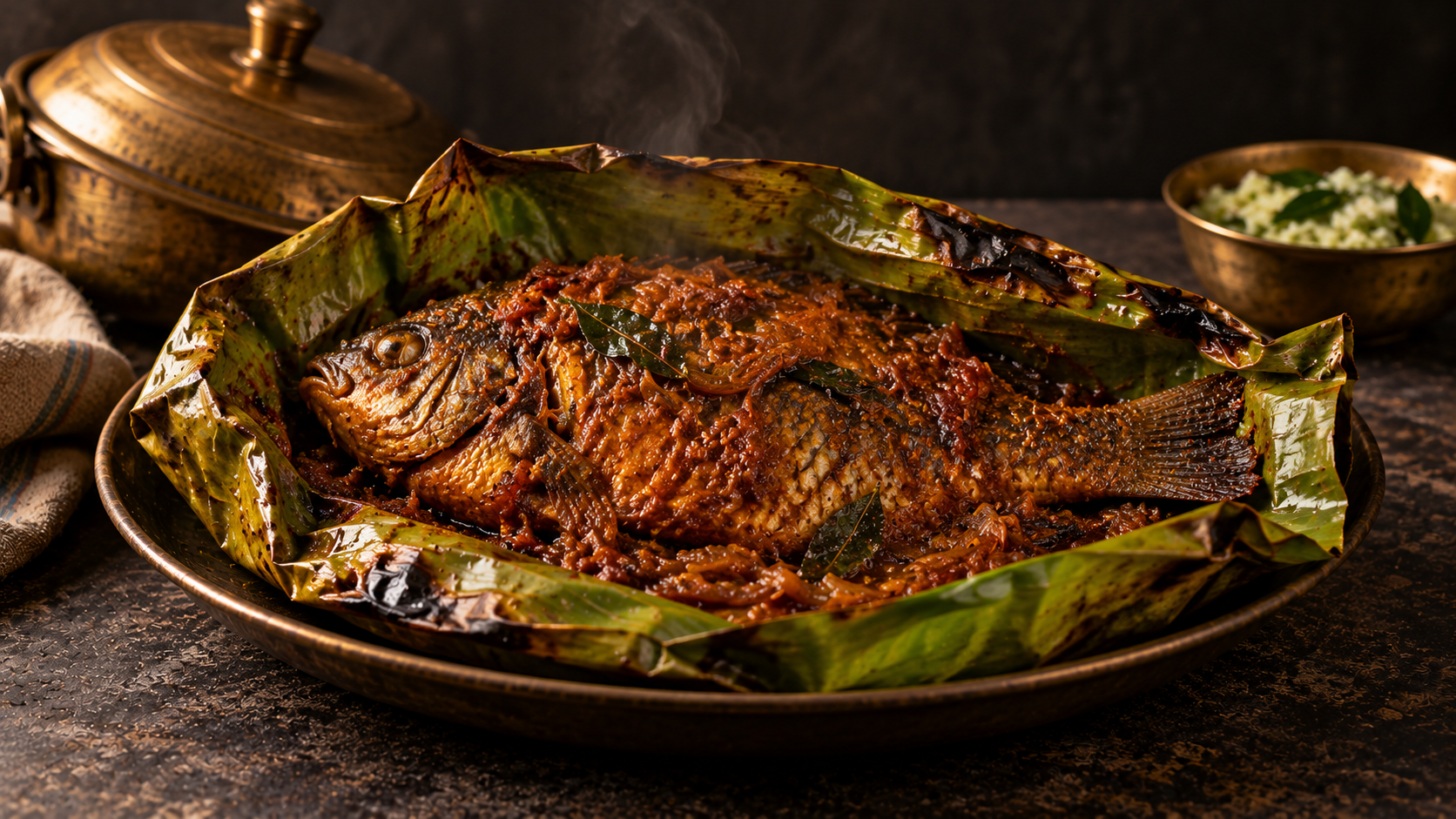
Cook the entire parcel until the banana leaf chars gently, the fish steams in its own juices and the masala clings to every crevice.
Then open it.
Steam rises.
Spice.
Fish.
Coconut oil.
Banana-leaf aroma.
The person at the neighbouring table immediately regrets what they ordered.
What shall we call it?
The fish is Karimeen.
The technique is Pollichathu.
Problem solved.
First Kerala.
Then India.
Then the world.
What History Says
Karimeen is the Malayalam name for the pearl spot, Etroplus suratensis, a fish strongly associated with Kerala's brackish backwaters, including systems such as Vembanad and Ashtamudi.
Karimeen Pollichathu refers to a traditional preparation in which seasoned fish is wrapped—commonly in banana leaf—and cooked.
The leaf performs several functions. It helps retain moisture, shields the fish from harsh direct heat and contributes aroma as it softens and chars.
There is an interesting culinary parallel with the Parsi dish Patra ni Machhi, in which fish coated in a coriander-coconut-green-chilli chutney is wrapped in banana leaf and typically steamed.
The resemblance does not establish that one directly created the other. Leaf-wrapped cooking occurs in many cuisines.
Their flavour identities are also quite different: Karimeen Pollichathu belongs firmly to Kerala's chilli, shallot, curry-leaf and coconut-oil flavour world.
The Last Bite
Perhaps nobody stood beside Vembanad and announced:
“Today Kerala shall invent edible packaging.”
But fish, spice and banana leaf eventually found one another.
And frankly, none of them had any reason to separate after that.