
HERBS & LEAVES · 02
CORIANDER LEAVES
The Fresh Finish
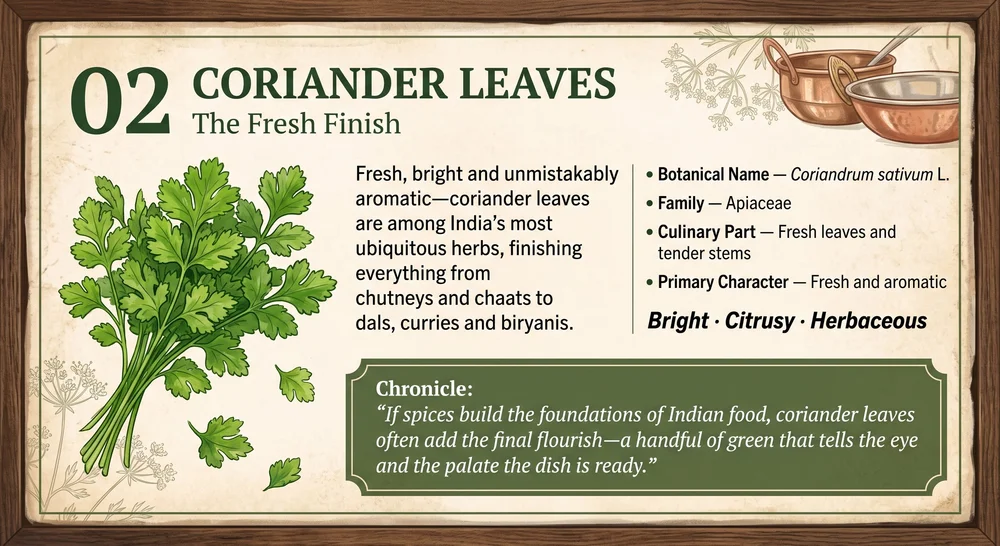
THE LEAF
One plant gives the Indian kitchen two remarkably different ingredients.
The dried fruit commonly called coriander seed is warm, earthy and citrus-like.
The fresh leaves are bright, green and immediate.
Tender stems are flavourful too and can be used in chutneys, marinades and masalas rather than automatically discarded.
For this collection, Coriander Leaves is a separate culinary Master from Coriander Seed.
NAMES ACROSS INDIA
English — Coriander Leaves / Fresh Coriander / Cilantro
Hindi — Dhania
Telugu — Kothimeera
Tamil — Kothamalli
Malayalam — Malliyila
Kannada — Kottambari Soppu
Marathi — Kothimbir
Gujarati — Dhana / Kothmir
Bengali — Dhone Pata
Konkani — Kothambari
ORIGIN & JOURNEY
Coriander is an ancient cultivated plant associated with the Mediterranean, West Asia and adjoining regions.
Over centuries both its seed and leaf became deeply integrated into Indian food.
The seed became part of the spice architecture.
The leaf became one of the great finishing herbs of the Indian kitchen.
WHERE INDIA USES IT
Essentially nationwide.
It appears in northern dals and sabzis, western snacks, Maharashtrian cooking, Gujarati farsan, Punjabi dishes, southern chutneys, Telugu cooking, rice dishes and street chaats.
IN THE KITCHEN
Coriander leaves are:
chopped as garnish
ground into chutney
combined with mint
used in marinades
worked into doughs and batters
added to dals and vegetables
scattered over rice
used in chaats and snacks
combined with coconut and chilli
Because prolonged cooking diminishes much of their fresh aroma, they are frequently added toward the end.
SIGNATURE DISHES
Dhaniya Chutney
Green Chutney
Kothimbir Vadi
Chaat
Dal Tadka
Biryani & Pulao
Kothamalli Chutney
Sabzis & Curries
FLAVOUR & AROMA
Green, citrusy, herbaceous and slightly peppery.
Its aroma often signals freshness before the flavour is consciously analysed.
Some people perceive coriander leaves as unusually soapy because of differences in olfactory perception.
CULTURE & TRADITION
Its cultural importance comes from ubiquity rather than ceremony.
The bunch at the vegetable market.
The chopping just before service.
The final scattering over a chaat.
Small gestures repeated millions of times become food culture.
THE CODEX NOTE
"Coriander rarely demands centre stage. Yet somehow, everyone notices when it fails to turn up."
It is garnish, herb, chutney, aroma, colour and freshness rolled into one.
The spices may have spent hours constructing the dish.
Coriander walks in during the final minute—
and takes the photograph.