
HERBS & LEAVES · 01
CURRY LEAVES
The Fragrant Leaf
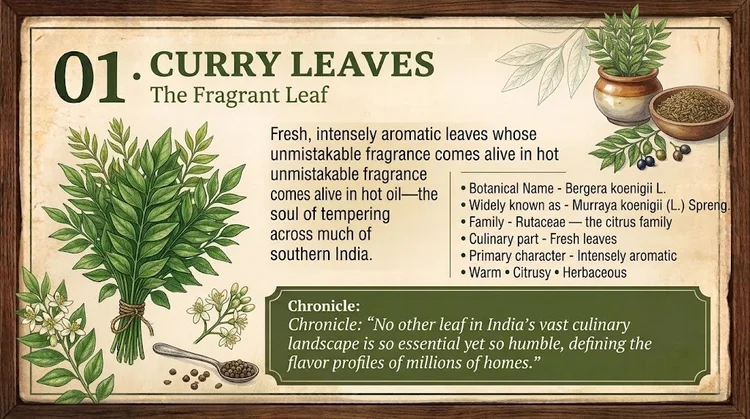
THE LEAF
Curry leaf is a tropical shrub or small tree belonging to the citrus family, Rutaceae. Its compound leaves carry glossy green leaflets whose unmistakable aroma is released when they are crushed or, most dramatically, when they meet hot oil.
That moment is fundamental to much of southern Indian cooking.
The leaf should not be confused with the vague Western culinary idea of "curry". Curry leaves are a specific botanical ingredient, not the ingredient responsible for turning a dish into a curry.
NAMES ACROSS INDIA
English — Curry Leaf / Curry Leaves
Hindi — Kadi Patta / Curry Patta / Mitha Neem
Tamil — Karuveppilai
Telugu — Karivepaku / Karepaku
Malayalam — Kariveppila
Kannada — Karibevu
Marathi — Kadhipatta / Karhinimb
Gujarati — Kadhilimbdo
Bengali — Barsanga / Kariphulli
Sanskrit — Krishna Nimba
ORIGIN & JOURNEY
Curry leaf is native to South and parts of Southeast Asia and has been deeply embedded in Indian cooking for generations.
Unlike chilli, it does not carry a Columbian Exchange story into India. It belongs to an older botanical relationship between the subcontinent and its surrounding tropical regions.
Its strongest culinary identity developed in southern and western Indian kitchens, where the leaf became integral to tempering, chutneys, powders, rice dishes and numerous regional preparations.
WHERE INDIA USES IT
Its strongest culinary presence is across Tamil Nadu, Kerala, Karnataka, Andhra Pradesh and Telangana, while it is also widely used in Maharashtra, Gujarat, Goa, Odisha and elsewhere.
For many households, the curry-leaf plant itself belongs close to the kitchen—a few steps from pan to plant.
IN THE KITCHEN
Curry leaves are famously used in tempering.
Mustard seed, cumin or other spices may enter hot oil first. Then the curry leaves hit the fat with their characteristic crackle, releasing aroma almost immediately.
They are also used in:
chutneys and podis
spice powders
curries and dals
rice preparations
coconut-based dishes
seafood and meat preparations
crisp-fried garnishes
Fresh leaves generally provide a more vivid aroma than dried leaves.
SIGNATURE DISHES
Sambar
Rasam
Coconut Chutney
Lemon Rice
Upma
Kerala Fish Curry
Karuveppilai Podi / Curry Leaf Powder
Curry Leaf Chutney
FLAVOUR & AROMA
Warm, green, citrus-like, savoury and slightly resinous.
Hot fat is particularly effective at carrying the aroma.
The sensory experience is often auditory before it is gustatory: the crackle in the pan announces what is coming.
CULTURE & TRADITION
Curry leaf belongs to everyday domestic cooking rather than grand ceremony.
A sprig plucked from a household plant and carried straight into a tempering pan is one of the quiet recurring gestures of southern Indian food culture.
THE CODEX NOTE
"Some ingredients announce themselves on the plate. Curry leaves announce themselves before the plate arrives."
A handful of leaves, a spoonful of hot oil, a few seconds of crackling—and an entire kitchen knows that cooking has begun.
That is the curry leaf's real power.
It doesn't merely flavour food.
It creates anticipation.