
HERBS & LEAVES · 11
DRUMSTICK LEAVES / MORINGA
The Giving Tree
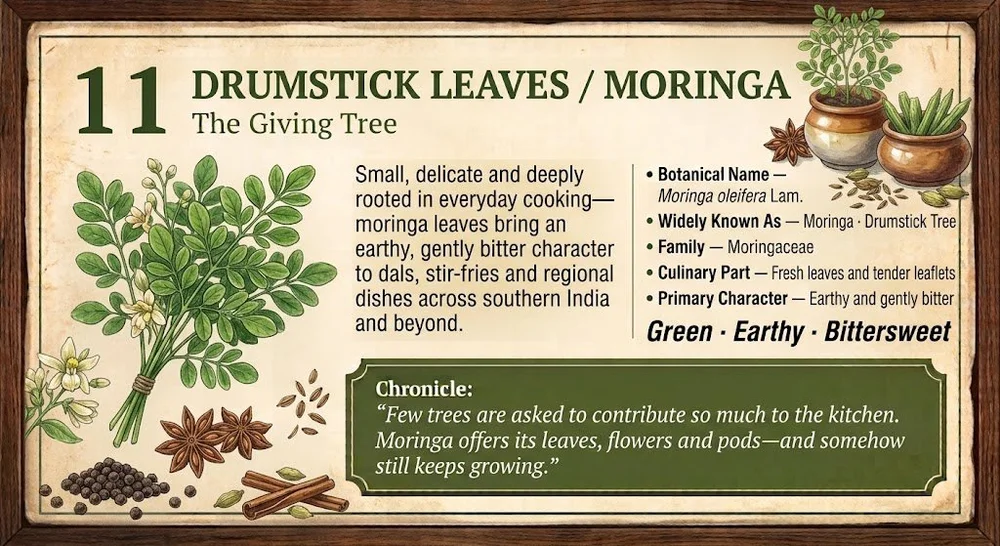
THE LEAF
Moringa makes the phrase "edible part" seem unnecessarily restrictive.
The pods enter sambars, curries and dals.
The flowers are eaten in regional traditions.
The small green leaflets form another culinary ingredient.
The compound leaves carry numerous small rounded leaflets which cook quickly and develop a green, earthy character with an underlying bitterness.
NAMES ACROSS INDIA
English — Moringa Leaves / Drumstick Leaves
Hindi — Sahjan ke Patte / Munga
Tamil — Murungai Keerai
Telugu — Munagaku
Malayalam — Muringayila
Kannada — Nugge Soppu
Marathi — Shevgyachi Pane
Bengali — Sojne Pata
Odia — Sajana Saga
ORIGIN & JOURNEY
Moringa oleifera is generally associated with the Indian subcontinent and adjoining South Asian region and has been cultivated for centuries.
It later travelled widely through tropical and subtropical regions.
Long before it became internationally marketed as a powdered "superfood", Indian households understood it more simply:
food.
WHERE INDIA USES IT
Particularly strong traditions across Tamil Nadu, Kerala, Andhra Pradesh, Telangana and Karnataka, with use extending into western, central and eastern cuisines.
IN THE KITCHEN
Moringa leaves may be:
cooked with dal
stir-fried
combined with coconut
used in poriyal/thoran-style preparations
added to soups and broths
cooked with pulses
incorporated into adai and batters
paired with eggs in some household traditions
SIGNATURE PREPARATIONS
Murungai Keerai Poriyal
Murungai Keerai Kootu
Munagaku Pappu
Muringayila Thoran
Nugge Soppu Palya
Moringa Leaf Adai
FLAVOUR & AROMA
Green, earthy, vegetal and gently bitter.
Coconut and lentils are natural partners.
CULTURE & TRADITION
Modern marketing presents moringa as powders, capsules and wellness blends.
For generations of Indian households, there was simply a tree.
The pods went into sambar.
The leaves became keerai, poriyal, dal or thoran.
Sometimes the flowers were cooked too.
THE CODEX NOTE
"The world discovered moringa as a superfood. Many Indian kitchens might reasonably respond: 'Yes. And?'"
The pods were already in the sambar.
The leaves were already in the dal.
The flowers had their own recipes.
Sometimes sustainability is not a new philosophy.
It is simply an old kitchen refusing to waste a perfectly good ingredient.