
HERBS & LEAVES · 12
COLOCASIA LEAVES
The Leaf That Must Be Tamed
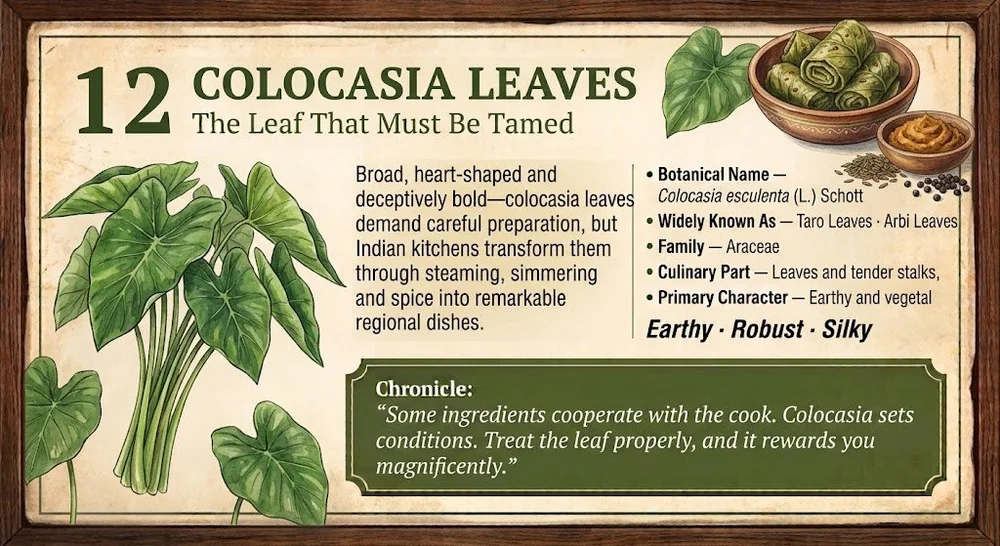
THE LEAF
Colocasia is a plant of many edible possibilities—and a few important rules.
The underground corm is commonly called arbi in much of northern India.
Above ground rise large, heart-shaped leaves carried on substantial stalks.
Those leaves are edible but not casually so.
Raw or inadequately prepared colocasia contains calcium oxalate crystals that can cause intense irritation of the mouth and throat.
Proper preparation and thorough cooking are essential.
Traditional kitchens understood this practically and developed techniques to tame the leaf.
NAMES ACROSS INDIA
English — Colocasia Leaves / Taro Leaves
Hindi — Arbi ke Patte
Gujarati — Arbi na Patta / Patra leaves
Marathi — Alu / Aluchi Pane
Konkani — Alu
Tamil — Seppankizhangu Ilai
Telugu — Chama Aaku
Malayalam — Chembila
Kannada — Kesuvina Ele
Bengali — Kochu Pata
Odia — Saru Patra
ORIGIN & JOURNEY
Colocasia is an ancient tropical food plant whose domestication and dispersal history extends across parts of South and Southeast Asia and the wider Indo-Pacific world.
Different communities learned to use different parts of the plant.
The corm became vegetable.
The leaves became another.
The stalks developed uses of their own.
WHERE INDIA USES IT
Rich traditions in Gujarat, Maharashtra, Goa, Konkan, Karnataka, Kerala, Bengal, Odisha and parts of South India.
IN THE KITCHEN
Leaves may be:
layered with seasoned gram-flour paste
rolled and steamed
sliced and tempered
simmered in curries
combined with coconut
cooked with pulses
used in regional leafy preparations
SIGNATURE DISHES
Patra
Alu Vadi
Aluchi Patal Bhaji
Pathrode / Patrode
Chembila preparations
Kochu Pata preparations
FLAVOUR & TEXTURE
Earthy, green and robust.
Proper cooking softens the leaves considerably.
In rolled preparations the leaf becomes almost inseparable from its spiced gram-flour layers.
CULINARY NOTE
Colocasia leaves should not be consumed raw and require proper preparation and thorough cooking.
CULTURE & TRADITION
Traditional culinary skill was also the knowledge of how to make difficult ingredients edible and enjoyable.
Bitterness had to be managed.
Fibres softened.
Foods fermented.
Seeds soaked.
Plants carefully cooked.
Colocasia belongs to that history.
THE CODEX NOTE
"Colocasia does not reward culinary laziness."
Indian cooks did not reject the difficult ingredient.
They learned its rules.
Layer it.
Season it.
Roll it.
Steam it.
Cook it thoroughly.
Cuisine is what happens when generations stop asking, "Can we eat this?" and start discovering, "How do we make this delicious?"