
HERBS & LEAVES · 13
BETEL LEAF
The Ceremonial Leaf
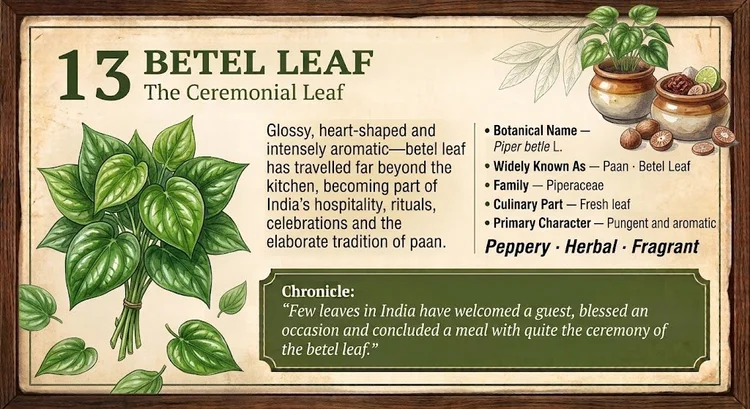
THE LEAF
Betel is a climbing vine belonging to Piperaceae, the same botanical family as black pepper.
Its glossy, heart-shaped leaves vary among cultivated forms in size, tenderness, pungency and aroma.
Some are delicate and relatively mild.
Others possess a pronounced peppery bite.
NAMES ACROSS INDIA
English — Betel Leaf
Hindi — Paan
Bengali — Paan
Gujarati — Paan
Marathi — Nagvel / Paan
Telugu — Tamalapaku
Tamil — Vetrilai
Malayalam — Vettila
Kannada — Veeledele
Odia — Pana
ORIGIN & JOURNEY
Betel has a very long association with South and Southeast Asia.
Over centuries it became integrated into trade, agriculture, hospitality, social custom and ritual across the Indian subcontinent.
It could be offered.
Exchanged.
Presented ceremonially.
Served after meals.
Used during religious and social occasions.
WHERE INDIA USES IT
Traditions extend across Bengal, Odisha, Uttar Pradesh, Bihar, Gujarat, Maharashtra, Andhra Pradesh, Telangana, Tamil Nadu, Karnataka, Kerala and elsewhere.
IN THE KITCHEN
Fresh leaves can be:
folded around sweet paan fillings
used in savoury paan preparations
incorporated into contemporary drinks
infused into syrups or beverages
adapted into desserts
PAAN & LEAF TRADITIONS
Meetha Paan
Banarasi Paan
Maghai Paan
Bengali Paan traditions
South Indian ceremonial betel
Contemporary betel creations
FLAVOUR & AROMA
Peppery, herbal, warm, fresh and intensely aromatic.
The precise flavour depends strongly on the variety.
CULTURE & TRADITION
Betel leaves appear across numerous communities in:
weddings
religious ceremonies
festivals
hospitality
offerings
auspicious exchanges
post-meal rituals
IMPORTANT DISTINCTION
Betel leaf, areca nut and tobacco are separate components.
Do not treat them as synonyms.
The cultural history of betel leaf must not be reduced to tobacco-containing paan.
THE CODEX NOTE
"A betel leaf can begin as agriculture and end as etiquette."
It may welcome a guest.
Appear at a wedding.
Sit beside an offering.
Conclude a feast.
Sometimes understanding what people eat is not enough.
We also need to understand what they offer one another.