
!
HERBS & LEAVES · 14
BANANA LEAF
The Plate Before Plates
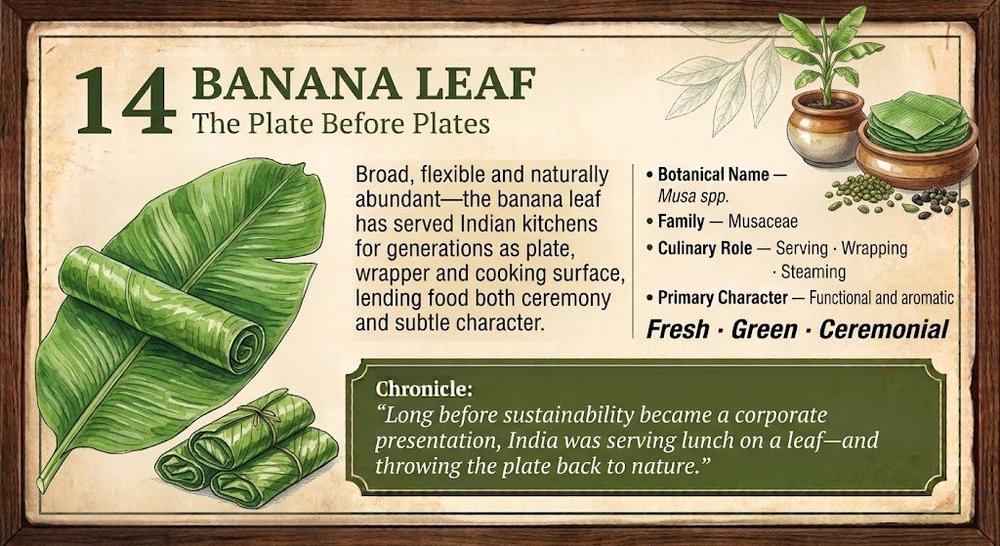
THE LEAF
Few leaves have participated in an Indian meal as completely as the banana leaf.
It can hold the meal.
Wrap the food.
Protect it during cooking.
Provide a surface for steaming.
And occasionally contribute a gentle vegetal aroma when heated.
Unlike curry leaves, mint or coriander, banana leaf does not primarily contribute flavour by being eaten.
Its culinary importance lies in what food happens upon it.
NAMES ACROSS INDIA
English — Banana Leaf
Hindi — Kele ka Patta
Telugu — Arati Aaku
Tamil — Vazhai Ilai
Malayalam — Vazhayila
Kannada — Bale Ele
Marathi — Keliche Paan
Bengali — Kola Pata
Odia — Kadali Patra
ORIGIN & JOURNEY
Bananas belong to an ancient group of plants domesticated and dispersed across South and Southeast Asia and the wider tropical world.
India became home to extraordinary banana diversity and multiple culinary uses for the plant.
WHERE INDIA USES IT
Especially visible across Tamil Nadu, Kerala, Karnataka, Andhra Pradesh and Telangana, but culinary use extends into Bengal, Odisha, Maharashtra, Goa, Konkan, Northeast India and elsewhere.
IN THE KITCHEN
Banana leaves can be:
used as natural plates
wrapped around fish
wrapped around rice and fillings
used for steaming
placed beneath foods during cooking
used to line vessels
used beneath sweets and snacks
used for festive meals
Before wrapping, cooks often soften the leaf briefly over heat.
ON THE LEAF & IN THE LEAF
Kerala Sadya
Tamil Virundhu / Banana-Leaf Feast
Patra ni Machhi
Meen Pollichathu
Panki
Ela Ada
Paturi traditions
FLAVOUR & AROMA
The influence is subtle.
When heated, banana leaf can contribute a gentle green, vegetal aroma.
Its greater contribution is physical:
holding moisture
separating food
providing structure
creating parcels
serving food
CULTURE & TRADITION
Meals served on leaves are associated in several communities with festivals, weddings, temple traditions, community feasts, religious occasions and hospitality.
The leaf can turn eating into ritual.
THE WHOLE PLANT
Fruit — eaten ripe.
Raw Banana — cooked as vegetable.
Flower / Blossom — used in regional dishes.
Inner Pseudostem — cooked in several traditions.
Leaf — serving, wrapping and steaming.
Traditional cuisines often understand plants as systems, not products.
THE CODEX NOTE
"Before plates came from factories, some of them grew in the backyard."
A banana leaf could host a wedding feast.
Steam a parcel of fish.
Wrap a sweet.
Carry lunch.
Today we might call that sustainable design.
The older kitchen had a shorter name for it:
a leaf.