
HERBS & LEAVES · 15
GARLIC CHIVES
The Gentle Allium
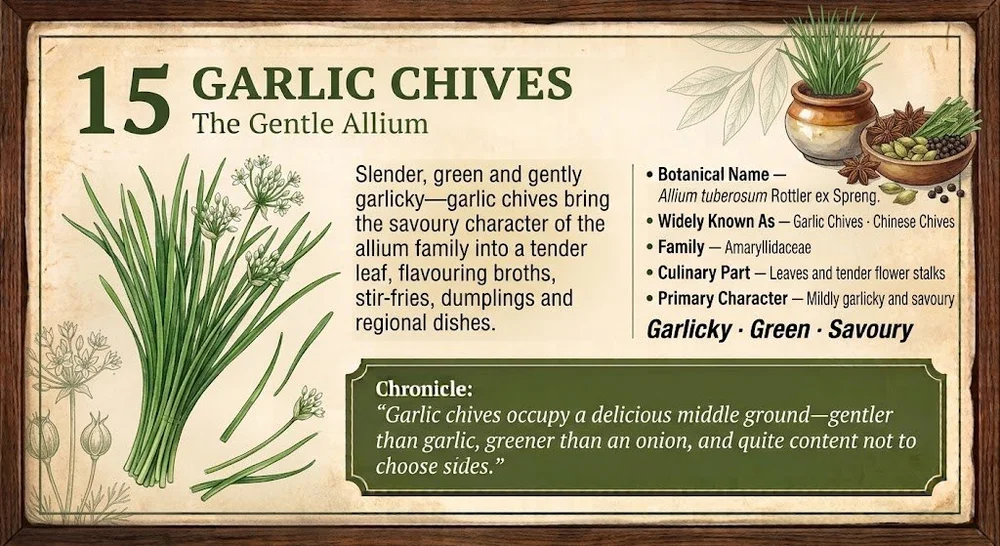
THE LEAF
Garlic chives belong to the great Allium family—the culinary family that gives us onions, garlic, leeks and chives.
They should not be confused with ordinary chives.
Allium tuberosum produces long, flat, strap-like leaves unlike the hollow tubular leaves of common chives.
Cut one and its identity becomes clearer.
There is unmistakable garlic in the aroma, but without the concentrated pungency of a garlic clove.
NAMES & REGIONAL IDENTITY
English — Garlic Chives
Also Known As — Chinese Chives
Botanical — Allium tuberosum
Across Northeastern and Himalayan regions, local names vary by community and may sometimes refer to related cultivated or wild alliums.
Do not invent a pan-Indian language table.
ORIGIN & JOURNEY
Garlic chives are associated botanically and culturally with East and Central Asia.
Their presence in India's eastern Himalayan and Northeastern food landscape reflects wider movement, trade, agriculture and cultural exchange with Tibet, China, Myanmar and Southeast Asia.
WHERE INDIA USES IT
Most relevant to Northeastern India, Sikkim and Himalayan communities rather than mainstream plains cooking.
IN THE KITCHEN
Garlic chives can be:
chopped into stir-fries
added to broths and soups
incorporated into dumpling fillings
cooked with eggs
combined with meat
tossed with vegetables
added to noodles
used as a finishing herb
REGIONAL PREPARATIONS
Dumpling fillings
Egg and chive preparations
Broths and soups
Stir-fried greens
Noodle preparations
Meat and vegetable preparations
FLAVOUR & AROMA
Garlicky, green, savoury and mildly sweet.
Garlic may form the foundation of a dish.
Garlic chives can form part of its freshness.
CULTURE & TRADITION
Indian culinary influence did not arrive only from the northwest.
India also meets Tibet, Bhutan, China, Myanmar and Southeast Asia.
The cuisines of the Northeast and Himalayas reflect those geographical and cultural conversations.
THE CODEX NOTE
"Borders belong to maps. Ingredients have always been more adventurous."
A leaf does not stop growing because someone drew a political boundary.
A cooking technique does not require a passport.
To understand Indian food, sometimes we simply need to turn the map around.