
HERBS & LEAVES · 16
GONGURA
The Sour Leaf
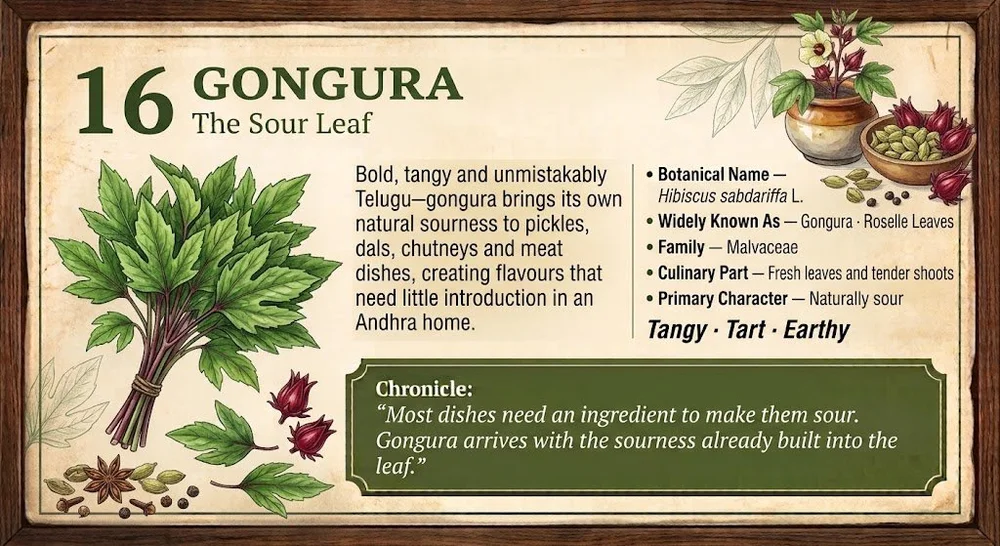
THE LEAF
Gongura is the culinary leaf of Hibiscus sabdariffa, commonly known as roselle.
In the Telugu kitchen it needs little botanical introduction.
It is simply Gongura.
The leaves possess distinctive natural acidity.
Green-stemmed and red-stemmed forms are encountered.
Unlike a mild green waiting for spices to give it character, Gongura arrives with a personality already fully formed.
NAMES ACROSS INDIA
English — Roselle Leaves
Telugu — Gongura
Hindi — Ambadi / Lal Ambari
Marathi — Ambadi
Kannada — Pundi Soppu
Tamil — Pulicha Keerai
Malayalam — regional names vary
Bengali — Mesta / related regional names
ORIGIN & JOURNEY
Roselle has a complex history across the tropical Old World, and its precise centre of domestication has been debated.
Do not assign it a simplistic single-origin story.
What matters here is the depth of its relationship with Indian regional food traditions.
WHERE INDIA USES IT
Gongura has an especially powerful association with Telugu cuisine in Andhra Pradesh and Telangana.
Related roselle greens appear elsewhere under regional names.
IN THE KITCHEN
Gongura can be:
cooked into chutney
preserved as pickle
combined with dal
cooked with mutton
paired with chicken
sautéed with chillies and aromatics
mixed with rice
SIGNATURE DISHES
Gongura Pachadi
Gongura Pickle
Gongura Pappu
Gongura Mutton
Gongura Chicken
Gongura Rice
Ambadi / Roselle Green preparations
FLAVOUR & AROMA
Gongura is defined above all by sourness.
Not lemon-like freshness.
Not tamarind's dark fruitiness.
Not vinegar.
It possesses its own leafy acidity and earthy green character.
CULTURE & TRADITION
For many Telugu families, its significance lies in familiarity.
A jar of Gongura pickle.
Hot rice.
A spoonful of ghee.
Taste memory can collapse geography remarkably quickly.
THE CODEX NOTE
"Every region has an ingredient that outsiders taste and locals recognise. Gongura belongs firmly in the second category."
Some foods tell you about a place.
Others take you back there.
Gongura does both.