
HERBS & LEAVES · 04
FENUGREEK LEAVES
The Bittersweet Green
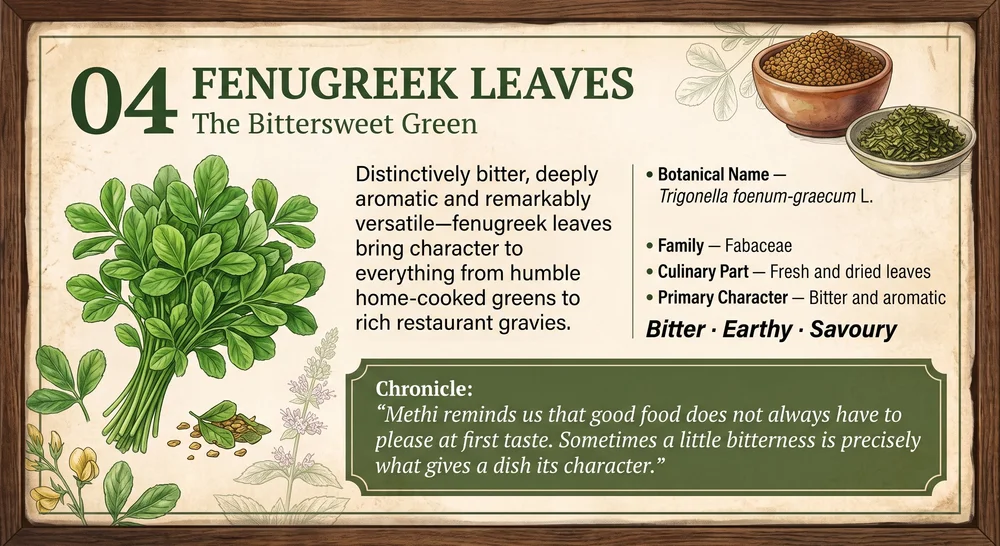
THE LEAF
Fenugreek is one plant speaking several culinary languages.
Its seeds are hard, angular, aromatic and bitter.
Its leaves are a green vegetable and herb—fresh, tender and pleasantly bitter.
Then there is kasuri methi: dried fenugreek leaves.
Drying transforms the leaf into a concentrated, warm aromatic seasoning. Crushed between the palms and scattered into a finished gravy, a small quantity can change an entire dish.
One plant.
Seed, fresh green and dried herb.
Different culinary jobs.
NAMES ACROSS INDIA
English — Fenugreek Leaves
Hindi — Methi
Punjabi — Methi
Marathi — Methi
Gujarati — Methi
Bengali — Methi Shak
Telugu — Menthi Kura
Tamil — Vendhaya Keerai
Kannada — Menthe Soppu
Malayalam — Uluva Ila
Dried fenugreek leaves are widely known as Kasuri Methi / Kasoori Methi.
ORIGIN & JOURNEY
Fenugreek is an ancient Old World crop with a long history extending through the Mediterranean, West Asia and South Asia.
India developed especially broad uses for it.
The seed became spice.
The fresh leaf became vegetable and herb.
The dried leaf became aromatic seasoning.
WHERE INDIA USES IT
Fenugreek leaves are particularly prominent across North and Western India, including Punjab, Rajasthan, Gujarat and Maharashtra, while regional preparations occur much more widely.
Fresh methi often speaks the language of the home kitchen.
Kasuri methi frequently speaks the language of the restaurant kitchen.
IN THE KITCHEN
Fresh methi can be:
sautéed
cooked with potatoes
combined with dal
kneaded into dough
mixed into thepla
cooked with peas
paired with paneer
incorporated into rice
combined with meat
Kasuri methi is generally used in much smaller quantities and often rubbed between the palms before being added near the end of cooking.
SIGNATURE DISHES
Aloo Methi
Methi Thepla
Methi Paratha
Methi Dal
Methi Matar Malai
Methi Chicken
Methi Pulao
North Indian gravies finished with Kasuri Methi
FLAVOUR & AROMA
Fresh methi is green, earthy, herbaceous and bitter.
Dried kasuri methi becomes considerably more concentrated and aromatic, with warm, savoury and slightly sweet-hay-like notes.
Indian cuisine understands the usefulness of bitterness.
In the right proportion, bitterness creates contrast.
And contrast creates appetite.
CULTURE & TRADITION
Methi belongs strongly to seasonal and everyday cooking.
Fresh bunches appearing in winter markets can determine what is cooked that day.
Drying the leaf extends its usefulness far beyond the harvest.
Kasuri methi therefore asks an old culinary question:
How do you preserve a season?
You dry it.
THE CODEX NOTE
"Methi makes no attempt to hide its bitterness—and perhaps that is precisely why Indian kitchens learned to love it."
Pair it with potato and it finds balance.
Fold it into bread and it becomes comforting.
Add cream and peas and bitterness acquires elegance.
Dry the leaves, crush them between your palms and scatter them into a gravy—
and the quiet green from the vegetable market becomes perfume.