
HERBS & LEAVES · 05
HOLY BASIL / TULSI
The Sacred Leaf
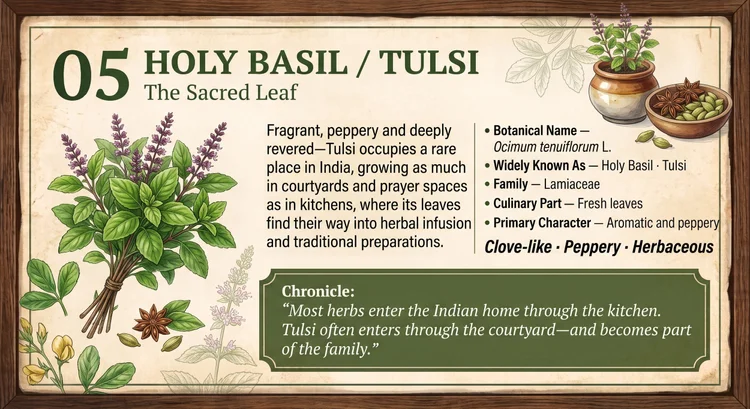
THE LEAF
Tulsi is not simply India's version of culinary basil.
It is a distinct aromatic plant, Ocimum tenuiflorum, belonging to the mint family.
Its leaves are aromatic, slightly peppery and often carry warm, clove-like notes.
Several cultivated forms are recognised in India, including forms commonly described as Rama Tulsi and Krishna or Shyama Tulsi.
But reducing Tulsi to botanical description misses its significance.
For millions of Indian households, this is a plant with a cultural life.
NAMES ACROSS INDIA
English — Holy Basil / Sacred Basil
Hindi — Tulsi
Sanskrit — Tulasi
Telugu — Tulasi
Tamil — Thulasi
Malayalam — Tulasi
Kannada — Tulasi
Marathi — Tulsi
Gujarati — Tulsi
Bengali — Tulsi
ORIGIN & JOURNEY
Tulsi belongs to tropical and subtropical Asia and has been associated with the Indian subcontinent for centuries.
Its journey through Indian culture is difficult to separate neatly into plant, ritual, household tradition and traditional medicine because all of them overlap.
WHERE INDIA USES IT
Tulsi is found across much of India, but its geographic importance cannot be mapped simply by asking where it is cooked.
Traditionally, plants have been maintained in courtyards, verandas and dedicated structures such as Tulsi Vrindavan or Tulsi Chaura.
Culinarily, its use is specialised—particularly herbal drinks, infusions and household preparations rather than routine use as a major cooking herb.
IN THE KITCHEN
Tulsi may appear in:
herbal infusions
Tulsi tea
warm spiced drinks
household decoctions
flavoured beverages
contemporary culinary interpretations
Tulsi is not interchangeable with Italian sweet basil.
TRADITIONAL PREPARATIONS
Tulsi Infusion
Tulsi Chai
Tulsi-Ginger Infusion
Tulsi Herbal Kadha
Contemporary Tulsi Drinks
FLAVOUR & AROMA
Peppery, herbaceous, warm and clove-like.
Its aroma is considerably more assertive than many conventional culinary basils.
CULTURE & TRADITION
In Hindu traditions, Tulsi is sacred and closely associated with Vishnu and Krishna.
Tulsi Vivah symbolically celebrates the marriage of Tulsi with Vishnu or one of his forms and is observed in parts of India.
The courtyard Tulsi plant can represent the meeting point of home, nature, ritual and everyday life.
THE CODEX NOTE
"Some plants are cultivated for what they give the kitchen. Tulsi is cultivated for what it gives the home."
Its deepest Indian story is not written only in recipes.
It is written in courtyards, verandas and morning rituals—in the small patch of earth where generations have watered the same kind of plant before beginning their day.