
HERBS & LEAVES · 18
PANDAN / FRAGRANT SCREW PINE
The Perfumed Leaf
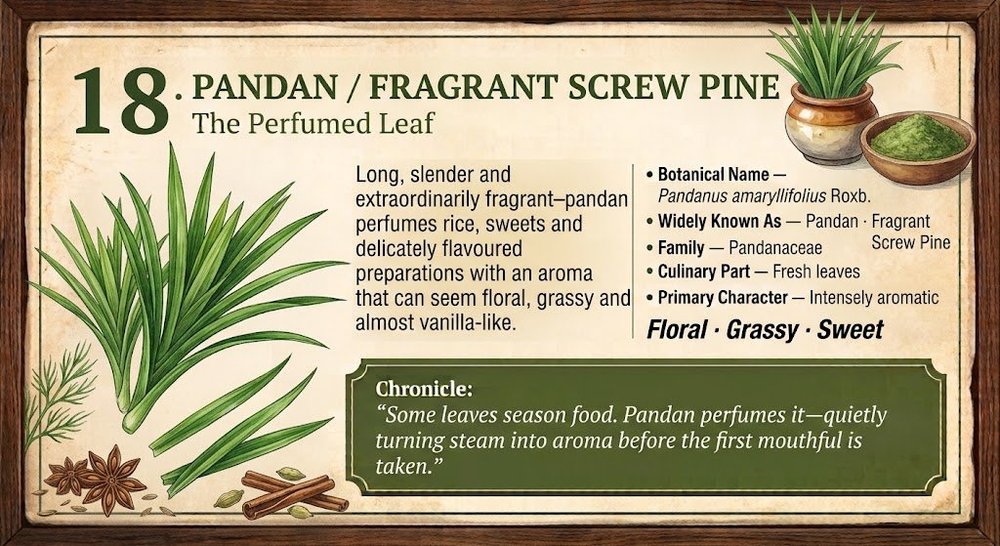
THE LEAF
Pandan looks nothing like the soft culinary herbs that precede it.
Its leaves are long, narrow and blade-like.
Its real identity is revealed by aroma.
Crush or heat the leaves and they release a scent that is green and grassy, yet sweet, warm and reminiscent of vanilla or fragrant rice.
One compound strongly associated with that characteristic aroma is 2-acetyl-1-pyrroline, also associated with fragrant rice varieties.
NAMES & IDENTITY
English — Pandan / Fragrant Screw Pine
Common Culinary Name — Pandan Leaf
Botanical — Pandanus amaryllifolius
Regional terminology can overlap with other members of Pandanus.
This Master concerns fragrant culinary pandan used for flavouring food—not every plant commonly called screw pine.
ORIGIN & JOURNEY
Pandan's deepest culinary identity belongs to tropical Southeast Asia.
India sits beside that culinary world.
Across the Bay of Bengal, through coastal trade, migration and cultural exchange, ingredients and techniques have moved between eastern India, the Northeast, island communities and Southeast Asia for centuries.
WHERE INDIA USES IT
Describe pandan as having a specialised rather than universal Indian culinary presence.
Do not imply it is a common pan-Indian household herb.
IN THE KITCHEN
Fresh pandan leaves can be:
tied into knots and cooked with rice
steeped in coconut milk
infused into milk or syrup
used to perfume sweets
incorporated into drinks
used as wrappers
blended and strained
used in steamed preparations
PANDAN IN THE KITCHEN
Fragrant Rice
Coconut & Pandan
Pandan-Infused Milk
Steamed Sweets
Pandan Drinks
Wrapped & Steamed Foods
FLAVOUR & AROMA
Fresh grass.
Flowers.
Vanilla.
Warm sweetness.
Fragrant rice.
It works especially well with:
rice
coconut
milk
palm sugar
jaggery
tropical fruits
PANDAN IS NOT KEWRA
PANDAN
Primarily the aromatic leaf
Used widely in Southeast Asian cooking
Green, warm, grassy-sweet aroma
KEWRA
Traditionally associated with fragrant male flowers of Pandanus odorifer
Distilled into kewra water / essence
Important in several North Indian and Mughlai-style sweets, rice dishes and festive preparations
More distinctly floral and perfumed
Do not treat Pandan and Kewra as interchangeable.
CULTURE & TRADITION
Pandan reminds us that India's food story has never existed in isolation.
To the west lie Persia, Arabia and Central Asia.
To the east lie Myanmar and Southeast Asia.
To the south stretch maritime routes across the Indian Ocean.
Plants travelled.
People travelled.
Recipes travelled.
THE CODEX NOTE
"A map may show where a country ends. A kitchen often shows where cultures meet."
Tie a pandan leaf into a pot of rice and something remarkable happens.
The leaf remains almost invisible.
The aroma doesn't.
Leaves are often the quietest ingredients in the kitchen—and some of the most powerful storytellers.