
Episode 08 / Jalebi
When Batter Became Calligraphy
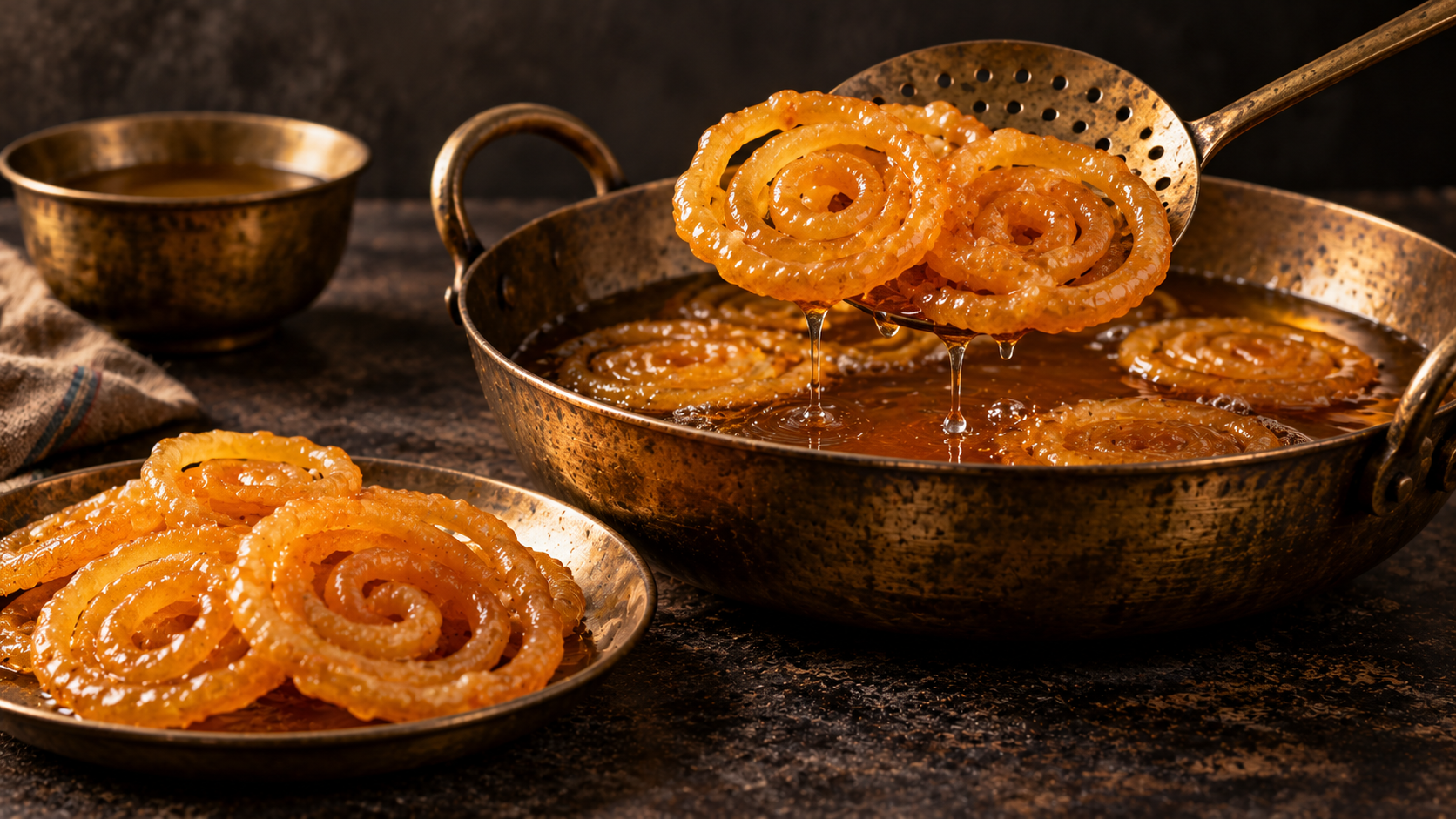
The Curious Thought
“Yeh toh ekdum jalebi ki tarah seedha hai.”
Whoever invented jalebi deserves a medal.
Not for simplicity.
For engineering—and a very unusual understanding of the word straight.
How on Earth Did This Happen?
Start with flour.
Ferment the batter.
Perhaps add enough structure to ensure it behaves.
Now take a cloth.
Punch a little hole into it.
Stand over a kadai of hot ghee or oil.
And instead of dropping tidy little spoonfuls like any reasonable cook—
draw.
Round and round.
Loop over loop.
Spiral into spiral.
Cross one line over another.
Geometry that would make a mathematics teacher resign.
Fry until crisp.
Excellent.
Now drain it.
Perfectly respectable so far.
Then, just when the structure has achieved maximum crunch:
dunk the entire thing in sugar syrup.
Obviously.
Because the objective was apparently to produce a crisp shell containing tiny hollow channels into which hot syrup could insinuate itself.
Crisp outside.
Syrupy inside.
A little fermented tang.
Enough sweetness to alter short-term memory.
Serve hot.
And then have the confidence to describe something complicated as:
“Jalebi jaisa seedha.”
Straight like a jalebi.
Nothing about jalebi is straight.
Not its shape.
Not its process.
Not the sugar rush.
Kaun sochta hai yeh sab?
Someone who looked at batter and declared:
“Today, I shall draw with it.”
What History Says
Jalebi has historical relatives in West Asian culinary traditions.
Medieval Arabic texts describe zalabiya, fried batter sweets that could be formed into various shapes and sweetened with syrup or honey. The names jalebi, zulabiya and Persian zolbiya are generally considered linguistically related.
By the medieval period, related preparations had clearly entered the Indian culinary world.
Indian texts from around the 15th century and later describe sweets resembling jalebi, suggesting that the technique had become established and localized.
Over time, the Indian version developed distinctive characteristics: fermented batter piped into coils, fried until crisp and soaked in sugar syrup.
Numerous regional variations subsequently appeared across the subcontinent.
So while the technique likely travelled through wider West and Central Asian cultural exchange, India enthusiastically adopted, adapted and regionalized it.
The Last Bite
Perhaps jalebi was not born in India.
But India certainly gave it citizenship.
Imported idea. Indian geometry. Edible calligraphy.